
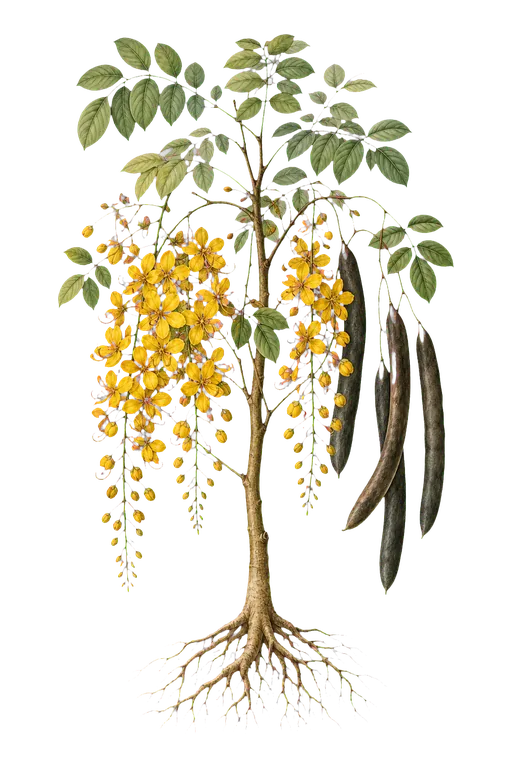
Amaltas / Indian Laburnum
Cassia fistula
Also known as Golden Shower, Purging Fistula, Fistula, Purging Cassia
- Habit
- Tree
- Found in India
- Maharashtra, Tamil Nadu, Telangana & more
- Flowering
- March-December
How to identify Amaltas
Identify Amaltas by combining habit, leaf characters, flower or fruit details, location, and its family pattern. Do not rely on one feature alone.
- Look for a tree habit.
- Check the distinctive field mark: Long hanging golden flower chains (golden shower).
- Confirm leaf type: Pinnately compound.
- Confirm flower colour: Yellow.
- Confirm flower arrangement: Raceme.
- Use the leaf pattern: alternate leaf arrangement, compound leaves, entire leaf margins, pinnate venation.
- In season, compare flowering and fruiting time: March-December.
Plant Details
- Scientific name
- Cassia fistula
- Genus
- Cassia
- Family
- Caesalpiniaceae
- Habit
- Tree
- Habitat
- Dry and moist deciduous forests
- Habitat type
- Forest
- Native to
- India, Sri Lanka
- Distribution
- India, Sri Lanka, Myanmar, Pakistan, Malay Islands, China
- Found in India
- Maharashtra, Tamil Nadu, Telangana, Karnataka, Kerala, Rajasthan, Gujarat, West Bengal, Delhi, Madhya Pradesh, Andhra Pradesh, Uttar Pradesh, Odisha, Goa, Chhattisgarh, Uttarakhand, Assam, Haryana, Bihar, Puducherry, Himachal Pradesh, Jharkhand, Punjab, Chandigarh, Jammu & Kashmir, Meghalaya, Mizoram, Tripura, Arunachal Pradesh, Sikkim
- Flowering & fruiting
- March-December
- Conservation status
- Not Evaluated (NE)
Leaf characters
- Leaf type
- Pinnately compoundrecordedLeaflets are arranged in rows along a central stalk, like a feather.“The leaves are deciduous, 15–60 cm (6–24 in) long, and pinnate with three to eight pairs of leaflets, each leaflet 7–21 cm (3–8 in) long and 4–9 cm (1+1⁄2–3+1⁄2 in) broad.” — Wikipedia, CC BY-SA 4.0
Typical of the family
- Arrangement
- Alternate


Characters marked “recorded” are for Amaltas itself; the rest are typical of the Caesalpiniaceae family.
Flower & fruit characters
- Flower colour
- Yellowrecorded
- Flower arrangement
- RacemerecordedIndividual stalked flowers arranged along a central stem, opening from bottom to top.“The flowers are produced in pendulous racemes 20–40 cm (8–16 in) long, each flower 4–7 cm (1+5⁄8–2+3⁄4 in) diameter with five yellow petals of equal size and shape.” — Wikipedia, CC BY-SA 4.0
- Fruit type
- LegumerecordedA dry pod that splits open along two seams (typical of the pea/bean family).“The fruit is a legume, 30–60 cm (12–24 in) long and 1.5–2.5 cm (9⁄16–1 in) broad, with a pungent odor and containing several seeds.” — Wikipedia, CC BY-SA 4.0
Typical of the family
- Flower symmetry
- Zygomorphic (bilaterally symmetrical)
- Inflorescence
- Raceme
- Fruit
- Legume
Characters marked “recorded” are for Amaltas itself; the rest are typical of the Caesalpiniaceae family — flowering plants only.
Local Names
- Hindi
- अमलतास Amaltas,अमलतास amalatas
- Nepali
- राजवृक्ष Raajavriksha, अमलतास Amalataas, राजवृक्ष
- Bengali
- সোনালী Sonali, Bandarlati, Amultas
- Tamil
- கொன்றை Konrai, கொன்றை, சரக்கொன்றை
- Telugu
- రేళ్ల చెట్టు, రేల, అరగ్వద
- Kannada
- ಕಕ್ಕೆ Kakke, ಆರಗು Aaragu, ಆರಗಿನ Aaragina, ಕಕ್ಕೆ ಗಿಡ
- Malayalam
- Kani Konna, Vishu konna, കണിക്കൊന്ന
- Marathi
- बहावा Bahava, बहावा, बाहवा
- Sanskrit
- अरग्वदवृक्षः
- Gujarati
- ગરમાળો
- Odia
- ସୁନାର ପୋଡା
- Punjabi
- ਅਮਲਤਾਸ
- Assamese
- সোণাৰু
- Sinhala
- ඇහැළ
Amaltas in India
Amaltas drapes Indian summers in cascades of gold — अमलतास Amaltas (Hindi), கொன்றை Konrai (Tamil), రేళ్ల చెట్టు (Telugu), ಕಕ್ಕೆ Kakke (Kannada), Kani Konna (Malayalam), बहावा Bahava (Marathi). Cassia fistula is planted across Maharashtra, Tamil Nadu, Telangana, Karnataka, Kerala, Rajasthan as an avenue and garden tree, and its bloom (kanikkonna) is central to Kerala's Vishu festival.
Uses
It is grown above all as an ornamental for its spectacular hanging chains of yellow flowers. The long cylindrical pods and pulp have attributed uses as a traditional laxative in Ayurveda — described for information, not medical advice. It is the state flower of Kerala.
How to Identify Amaltas
A medium tree that flowers in summer with long, pendulous sprays of bright yellow five-petalled flowers. The leaves are pinnate with several pairs of leaflets, and the distinctive fruit is a long, cylindrical, dark brown pod that rattles with seeds.
Frequently Asked Questions
- What is Indian Laburnum called in different Indian languages?
- अमलतास Amaltas (Hindi); கொன்றை Konrai (Tamil); రేళ్ల చెట్టు (Telugu); ಕಕ್ಕೆ Kakke (Kannada); Kani Konna (Malayalam); बहावा Bahava (Marathi); সোনালী Sonali (Bengali); ગરમાળો (Gujarati); ସୁନାର ପୋଡା (Odia); ਅਮਲਤਾਸ (Punjabi); अरग्वदवृक्षः (Sanskrit).
- When does amaltas flower?
- Amaltas flowers in the hot months, roughly April to June, hanging the tree with chains of golden blossom before and during early summer.
- What is the long black pod on the amaltas tree?
- It is the fruit — a long cylindrical pod containing seeds in dark pulp, which has attributed traditional medicinal uses.
Caesalpiniaceae
Senna family
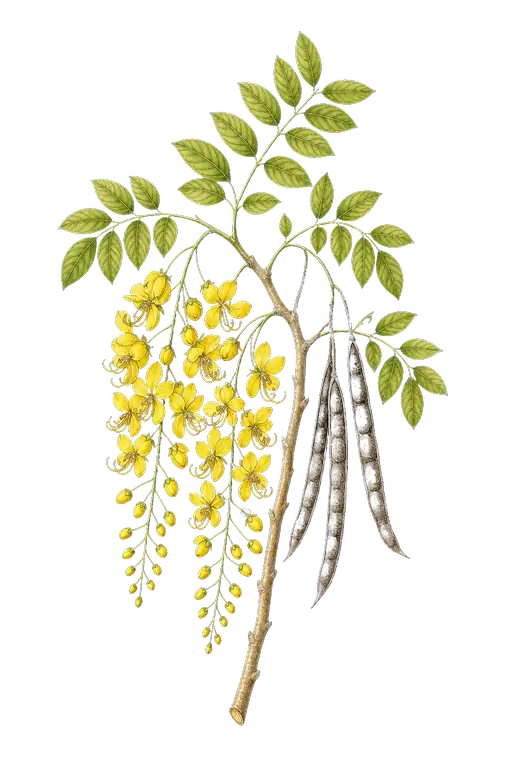
Amaltas belongs to the Caesalpiniaceae family.
The illustration represents the family — not necessarily this exact species.
Explore the Caesalpiniaceae familySnap it. Know it.
Point your camera at Amaltas or any plant and SASYA identifies it instantly — on-device, offline, and private.
Common plant problems
If you are starting from symptoms instead of a diagnosis, use the plant disease symptom checker to narrow the cause before treating.
All plant problem & care guidesMore in Caesalpiniaceae
View all CaesalpiniaceaeSources: GBIF — Cassia fistula (India distribution & vernacular names) (CC BY 4.0) · iNaturalist — Cassia fistula (regional names, India observations) (CC BY 4.0) · Wikipedia — Cassia fistula (background/comprehension only) (CC BY-SA 4.0)