
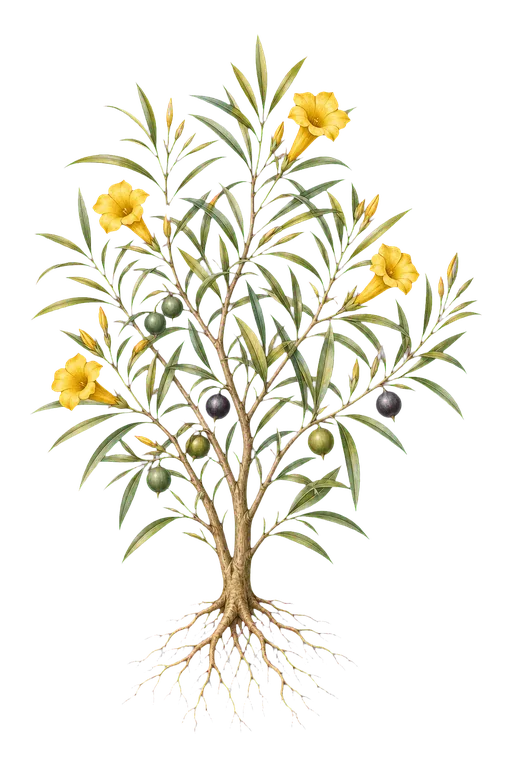
Peeli Kaner / Yellow Oleander
Cascabela thevetia
Also known as Bestill Tree
- Habit
- Tree
- Found in India
- Maharashtra, Tamil Nadu, Karnataka & more
- Flowering
- Throughout the year
How to identify Peeli Kaner
Identify Peeli Kaner by combining habit, leaf characters, flower or fruit details, location, and its family pattern. Do not rely on one feature alone.
- Look for a tree habit.
- Check the distinctive field mark: Poisonous yellow trumpet flowers, narrow glossy leaves.
- Confirm leaf shape: Lanceolate.
- Confirm flower colour: Yellow.
- Confirm fruit type: Nut.
- Use the leaf pattern: alternate leaf arrangement, simple leaves, entire leaf margins, pinnate venation.
- In season, compare flowering and fruiting time: Throughout the year.
Plant Details
- Scientific name
- Cascabela thevetia
- Genus
- Cascabela
- Family
- Apocynaceae
- Habit
- Tree
- Habitat
- Planted
- Habitat type
- Cultivated
- Native to
- Tropical America
- Distribution
- Naturalized in tropics
- Found in India
- Maharashtra, Tamil Nadu, Karnataka, Uttar Pradesh, Rajasthan, Madhya Pradesh, Odisha, West Bengal, Assam, Gujarat, Delhi, Chhattisgarh, Kerala, Andhra Pradesh, Haryana, Uttarakhand, Bihar, Goa, Telangana, Punjab, Himachal Pradesh, Mizoram, Puducherry, Arunachal Pradesh, Jharkhand, Tripura, Jammu & Kashmir, Lakshadweep, Meghalaya, Nagaland
- Flowering & fruiting
- Throughout the year
- Conservation status
- Not Evaluated (NE)
Leaf characters
- Leaf shape
- LanceolaterecordedLong and narrow, tapering to a point, like a lance head.“Its leaves are willow-like, linear-lanceolate, and glossy green in color.” — Wikipedia, CC BY-SA 4.0
Typical of the family
- Arrangement
- Alternate
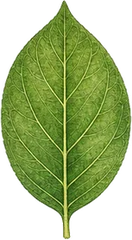


Characters marked “recorded” are for Peeli Kaner itself; the rest are typical of the Apocynaceae family.
Flower & fruit characters
- Flower colour
- Yellowrecorded
- Fruit type
- NutrecordedA hard-shelled, single-seeded fruit that does not split open.“Its fruit is deep red-black in color, encasing a large seed that bears some resemblance to a 'Chinese lucky nut.' Cascabela thevetia is effectively drought-resistant and tolerant t” — Wikipedia, CC BY-SA 4.0
Typical of the family
- Flower symmetry
- Actinomorphic (radially symmetrical)
- Inflorescence
- Cyme
- Fruit
- Follicle
Characters marked “recorded” are for Peeli Kaner itself; the rest are typical of the Apocynaceae family — flowering plants only.
Local Names
- Hindi
- Peeli kaner पीली कनेर,कनेर पीली kanera pili,पीला कनेर pila kaner
- Nepali
- पहेँलो करवीर
- Bengali
- কলকে, কলকে ফুল
- Tamil
- மஞ்சள் அரளி
- Telugu
- పచ్చ గన్నేరు
- Kannada
- ಕಾಡುಕಾಸಿಕಣಗಲು Kaadukaasi Kanagalu, ಕಾಡು ಕಣಿಗಿಲೆ
- Malayalam
- മഞ്ഞരളി
- Marathi
- बिट्टी / पिवळी कण्हेर
- Assamese
- কৰবী
- Sinhala
- කහ කනේරු
Peeli Kaner in India
Yellow oleander is a common hardy shrub with bright funnel flowers — Peeli kaner पीली कनेर (Hindi), மஞ்சள் அரளி (Tamil), పచ్చ గన్నేరు (Telugu), ಕಾಡುಕಾಸಿಕಣಗಲು Kaadukaasi Kanagalu (Kannada), മഞ്ഞരളി (Malayalam), बिट्टी / पिवळी कण्हेर (Marathi), the yellow-flowered kaner. Cascabela thevetia is planted across Maharashtra, Tamil Nadu, Karnataka, Uttar Pradesh, Rajasthan, Madhya Pradesh in gardens, hedges and road medians.
Uses
It is grown purely as an ornamental and tough hedge that flowers through much of the year. Its overriding feature is danger: every part, and especially the seeds, is highly poisonous, so it must never be eaten and is best kept away from children.
How to Identify Peeli Kaner
An evergreen shrub or small tree with narrow, glossy, willow-like leaves arranged spirally, exuding milky sap when cut. The bright yellow (sometimes apricot) flowers are funnel-shaped with a twist, followed by an angular green fruit that turns black.
Frequently Asked Questions
- What is Yellow Oleander called in different Indian languages?
- Peeli kaner पीली कनेर (Hindi); மஞ்சள் அரளி (Tamil); పచ్చ గన్నేరు (Telugu); ಕಾಡುಕಾಸಿಕಣಗಲು Kaadukaasi Kanagalu (Kannada); മഞ്ഞരളി (Malayalam); बिट्टी / पिवळी कण्हेर (Marathi); কলকে (Bengali).
- Is yellow oleander poisonous?
- Yes — all parts, especially the seeds, are highly toxic if eaten, so it should be handled with care and kept away from children despite being widely planted.
- How is it different from common oleander?
- Yellow oleander (Cascabela thevetia) has glossy willow-like leaves and yellow funnel flowers, while common oleander (Nerium) has flatter pink/white flowers and leaves in threes.
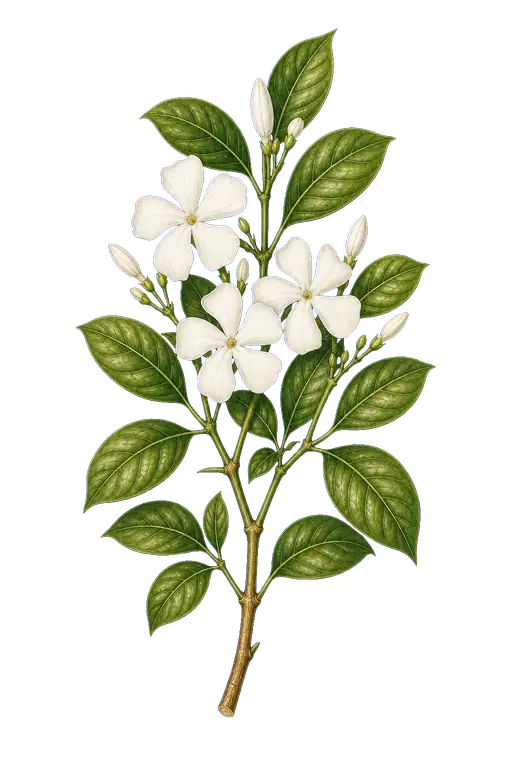
Apocynaceae
Dogbane family
Peeli Kaner belongs to the Apocynaceae family.
The illustration represents the family — not necessarily this exact species.
Explore the Apocynaceae familySnap it. Know it.
Point your camera at Peeli Kaner or any plant and SASYA identifies it instantly — on-device, offline, and private.
Common plant problems
If you are starting from symptoms instead of a diagnosis, use the plant disease symptom checker to narrow the cause before treating.
All plant problem & care guidesMore in Apocynaceae
View all ApocynaceaeSources: GBIF — Cascabela thevetia (India distribution & vernacular names) (CC BY 4.0) · iNaturalist — Cascabela thevetia (regional names, India observations) (CC BY 4.0) · Wikipedia — Cascabela thevetia (background/comprehension only) (CC BY-SA 4.0)