
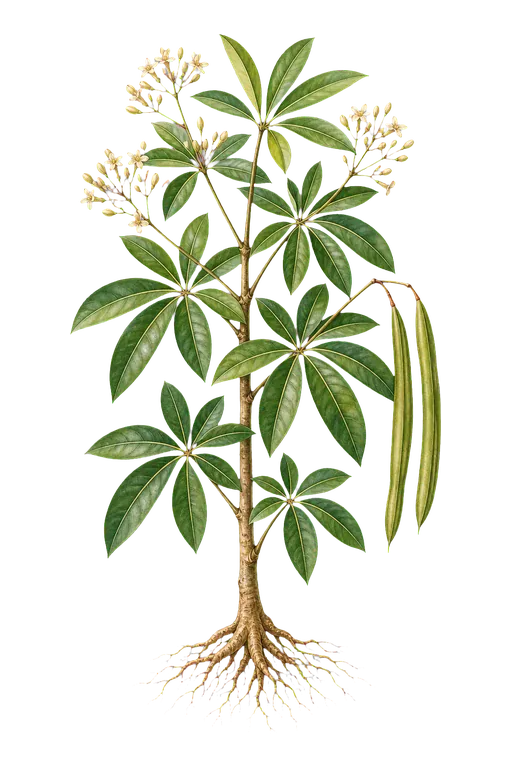
Saptaparni / Scholar Tree
Alstonia scholaris
Also known as Devil Tree, Shaitaanwood Tree, Blackboard Tree, Milkwood Pine, White Cheesewood, Dita Bark, Seven Leaved Tree
- Habit
- Tree
- Found in India
- Gujarat, Maharashtra, Kerala & more
- Flowering
- June-January
How to identify Saptaparni
Identify Saptaparni by combining habit, leaf characters, flower or fruit details, location, and its family pattern. Do not rely on one feature alone.
- Look for a tree habit.
- Check the distinctive field mark: Leaves in whorls of up to seven, milky sap, blackboard/devil tree.
- Confirm leaf arrangement: Whorled.
- Confirm leaf shape: Obovate.
- Confirm flower colour: White.
- Confirm flower arrangement: Cyme.
- In season, compare flowering and fruiting time: June-January.
Plant Details
- Scientific name
- Alstonia scholaris
- Genus
- Alstonia
- Family
- Apocynaceae
- Habit
- Tree
- Habitat
- Moist deciduous forests
- Habitat type
- Forest
- Native to
- Australia, Asia
- Distribution
- Tropical Africa, Asia, Australasia
- Found in India
- Gujarat, Maharashtra, Kerala, Tamil Nadu, Telangana, West Bengal, Karnataka, Rajasthan, Andhra Pradesh, Uttar Pradesh, Odisha, Delhi, Assam, Madhya Pradesh, Bihar, Uttarakhand, Goa, Chhattisgarh, Jharkhand, Puducherry, Punjab, Chandigarh, Arunachal Pradesh, Andaman & Nicobar Islands, Haryana, Himachal Pradesh, Meghalaya, Mizoram, Sikkim, Tripura
- Flowering & fruiting
- June-January
- Conservation status
- Least Concern (LC)
Leaf characters
- Leaf arrangement
- WhorledrecordedThree or more leaves arise from the same point around the stem.“The leaves are glossy dark green above and pale below, and they are arranged in whorls of four to eight, with petioles (leaf stalks) around 5–15 mm (0.20–0.59 in) long.” — Wikipedia, CC BY-SA 4.0
- Leaf shape
- ObovaterecordedEgg-shaped but broader near the tip rather than the base.“The leaves are usually obovate (i.e.” — Wikipedia, CC BY-SA 4.0
Typical of the family



Characters marked “recorded” are for Saptaparni itself; the rest are typical of the Apocynaceae family.
Flower & fruit characters
- Flower colour
- Whiterecorded
- Flower arrangement
- CymerecordedA branched cluster where the central/terminal flower opens first.“The inflorescences are much branched (cymose), with peduncles up to 7 cm (2.8 in) long, and are produced at the ends of the branches.” — Wikipedia, CC BY-SA 4.0
- Fruit type
- FolliclerecordedA dry pod that splits open along a single seam.“The fruit is a pair of long papery follicles measuring up to about 30 cm (12 in) long and 6 mm (0.24 in) diameter.” — Wikipedia, CC BY-SA 4.0
Typical of the family
- Flower symmetry
- Actinomorphic (radially symmetrical)
- Inflorescence
- Cyme
- Fruit
- Follicle
Characters marked “recorded” are for Saptaparni itself; the rest are typical of the Apocynaceae family — flowering plants only.
Local Names
- Hindi
- सप्तपर्णी Saptaparni, शैतान का झाड Shaitan ka jhar, चितवन Chitvan,चितवन chitavan
- Nepali
- छतिवन Chhatiwan, छलामैन Chhalaamain, पालिमारा Paalimaaraa
- Bengali
- ছাতিম Chattim, ছাতিম গাছ, ছাতিম
- Tamil
- ஏழிலை பிள்ளை Ezilai piLLai முகும்பலை mukumpalai, ஏழிலைப்பாலை
- Telugu
- Daevasurippi, ఏడాకుల చెట్టు, ఏడాకుల పాల
- Kannada
- ಏೞೆಲೆ ಹಾಲೆ Aelele Haale, ಬಂತಲೆ Bantale, Doddapala
- Malayalam
- Daivappala, ഏഴിലംപാല
- Marathi
- Satvin, सातवीण, सातविण
- Sanskrit
- saptaparna
Saptaparni in India
This tree, known as सप्तपर्णी Saptaparni (Hindi), ஏழிலை பிள்ளை Ezilai piLLai முகும்பலை mukumpalai (Tamil), Daevasurippi (Telugu), ಏೞೆಲೆ ಹಾಲೆ Aelele Haale (Kannada), Daivappala (Malayalam), Satvin (Marathi), is a common tall evergreen across Indian towns and forests. Alstonia scholaris is found across Gujarat, Maharashtra, Tamil Nadu, Kerala, Karnataka, Rajasthan, often planted as a shade and avenue tree.
Uses
Its light, straight-grained wood was historically used for packing cases, boards and, in some regions, writing slates or blackboards — the source of its species name scholaris; the tree is also planted widely for shade.
How to Identify Saptaparni
A tall, straight evergreen with leaves arranged in distinctive whorls of typically seven around the stem (giving 'saptaparni', seven-leaved, its common Sanskrit-derived name). Small, strongly fragrant white flowers cluster at the branch tips, usually opening in autumn, followed by long, slender, hanging seed pods in pairs.
Frequently Asked Questions
- What is Scholar Tree called in different Indian languages?
- सप्तपर्णी Saptaparni (Hindi); ஏழிலை பிள்ளை Ezilai piLLai முகும்பலை mukumpalai (Tamil); Daevasurippi (Telugu); ಏೞೆಲೆ ಹಾಲೆ Aelele Haale (Kannada); Daivappala (Malayalam); Satvin (Marathi); ছাতিম Chattim (Bengali); saptaparna (Sanskrit).
- Why is it called the 'devil tree'?
- The English name comes from its strong, heavy night-time fragrance during autumn flowering, which some found overpowering or eerie — not from any toxicity.
- Why 'saptaparni'?
- The Sanskrit-derived name means 'seven-leaved', describing how its leaves typically radiate in whorls of seven around each stem node, though the exact count can vary.

Apocynaceae
Dogbane family
Saptaparni belongs to the Apocynaceae family.
The illustration represents the family — not necessarily this exact species.
Explore the Apocynaceae familySnap it. Know it.
Point your camera at Saptaparni or any plant and SASYA identifies it instantly — on-device, offline, and private.
Common plant problems
If you are starting from symptoms instead of a diagnosis, use the plant disease symptom checker to narrow the cause before treating.
All plant problem & care guidesMore in Apocynaceae
View all ApocynaceaeSources: GBIF — Alstonia scholaris (India distribution & vernacular names) (CC BY 4.0) · Wikipedia — Alstonia scholaris (background/comprehension only) (CC BY-SA 4.0)