
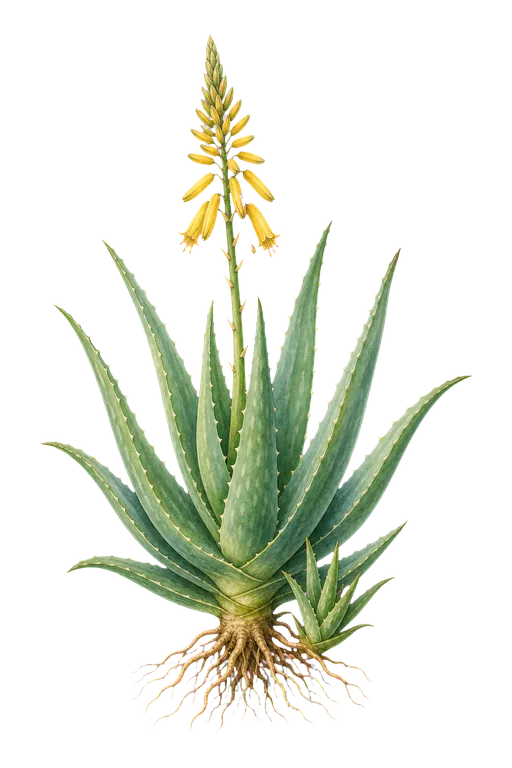
Gheekumari / True Aloe
Aloe vera
Also known as Indian Aloe, Jaffabad Aloe, Barbados Aloe
- Habit
- Herb
- Found in India
- Rajasthan, Maharashtra, Tamil Nadu & more
- Flowering
- September-January
How to identify Gheekumari
Identify Gheekumari by combining habit, leaf characters, flower or fruit details, location, and its family pattern. Do not rely on one feature alone.
- Look for a herb habit.
- Use the leaf pattern: basal leaf arrangement, simple leaves, spiny leaf margins, parallel venation.
- In season, compare flowering and fruiting time: September-January.
- In India, compare location records such as Rajasthan, Maharashtra, Tamil Nadu, Kerala and nearby regions.
- Confirm it sits within the Xanthorrhoeaceae family pattern, then compare close relatives before deciding it is Gheekumari.
Plant Details
- Scientific name
- Aloe vera
- Genus
- Aloe
- Family
- Xanthorrhoeaceae
- Habit
- Herb
- Habitat
- Dry deciduous forests and wasteland. Often planted
- Habitat type
- Forest, Cultivated, Wasteland
- Native to
- Mediterranean, Canary Islands
- Distribution
- Naturalized in most part of the World
- Found in India
- Rajasthan, Maharashtra, Tamil Nadu, Kerala, Andhra Pradesh, Gujarat, Karnataka, Goa, West Bengal, Himachal Pradesh, Madhya Pradesh, Odisha, Uttarakhand, Assam, Haryana, Telangana, Uttar Pradesh, Chandigarh, Chhattisgarh, Daman & Diu, Mizoram, Puducherry, Punjab
- Flowering & fruiting
- September-January
- Conservation status
- Not Evaluated (NE)
Leaf characters
- Arrangement
- Basal
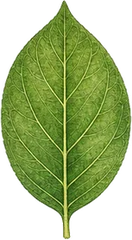
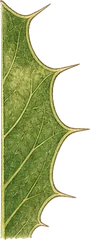

Characters marked “recorded” are for Gheekumari itself; the rest are typical of the Xanthorrhoeaceae family.
Flower & fruit characters
- Inflorescence
- Spike
Typical of the Xanthorrhoeaceae family — flowering plants only; individual species can differ.
Local Names
- Hindi
- Gheekumari घीकुमारी,घृत कुमारी ghrita kumari,अलो वेरा alo vera
- Nepali
- घ्यु कुमारी Ghyu Kumaari, घिउ कुमारी
- Bengali
- ঘৃতকুমারী
- Tamil
- கற்றாழை Kathalai, Aloe Verra, சோற்றுக்கற்றாழை
- Telugu
- కలబంద Kalabanda, కలబంద, అలోవెరా
- Kannada
- ಲೋಳೆ ಸರ
- Malayalam
- Kattar vazha, Cherukattazha, കറ്റാർവാഴ
- Marathi
- Khorpad, कोरफड
- Urdu
- کوار گندل
Gheekumari in India
Aloe vera is among the most widely grown household succulents in India — Gheekumari घीकुमारी (Hindi), கற்றாழை Kathalai (Tamil), కలబంద Kalabanda (Telugu), ಲೋಳೆ ಸರ (Kannada), Kattar vazha (Malayalam), Khorpad (Marathi). Easy to keep in a pot on any sunny ledge, it is cultivated across Rajasthan, Tamil Nadu, Maharashtra, Andhra Pradesh, Kerala, Gujarat for its leaf gel.
Uses
The clear gel inside the leaves is a familiar home remedy applied to the skin and hair and taken as juice — attributed traditional uses, not medical advice. It is grown commercially for cosmetics and the herbal trade, and is a forgiving, drought-tolerant pot plant.
How to Identify Gheekumari
A stemless succulent forming a rosette of thick, fleshy, grey-green lance-shaped leaves edged with small pale teeth and often flecked when young. Cut a leaf and it oozes clear gel within a rind that carries bitter yellow sap. Mature plants send up a tall spike of tubular yellow-orange flowers.
Frequently Asked Questions
- What is True Aloe called in different Indian languages?
- Gheekumari घीकुमारी (Hindi); கற்றாழை Kathalai (Tamil); కలబంద Kalabanda (Telugu); ಲೋಳೆ ಸರ (Kannada); Kattar vazha (Malayalam); Khorpad (Marathi); ঘৃতকুমারী (Bengali).
- What is aloe vera gel used for?
- The clear leaf gel is a popular home remedy applied to skin and hair and taken as juice; these are traditional, attributed uses and not medical advice.
- How do you care for aloe vera?
- Give it bright light, a free-draining pot and infrequent watering — it is a drought-tolerant succulent that rots if kept too wet.
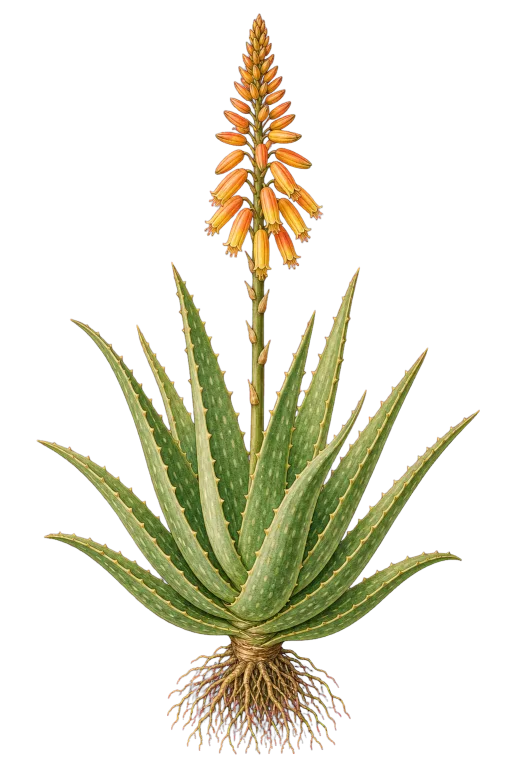
Xanthorrhoeaceae
Aloe Family
Gheekumari belongs to the Xanthorrhoeaceae family.
The illustration represents the family — not necessarily this exact species.
Explore the Xanthorrhoeaceae familySnap it. Know it.
Point your camera at Gheekumari or any plant and SASYA identifies it instantly — on-device, offline, and private.
Common plant problems
If you are starting from symptoms instead of a diagnosis, use the plant disease symptom checker to narrow the cause before treating.
All plant problem & care guidesSources: GBIF — Aloe vera (India distribution & vernacular names) (CC BY 4.0) · iNaturalist — Aloe vera (regional names, India observations) (CC BY 4.0) · Wikipedia — Aloe vera (background/comprehension only) (CC BY-SA 4.0)