Passifloraceae family
Passionflower family
13 catalogue species · Order Malpighiales
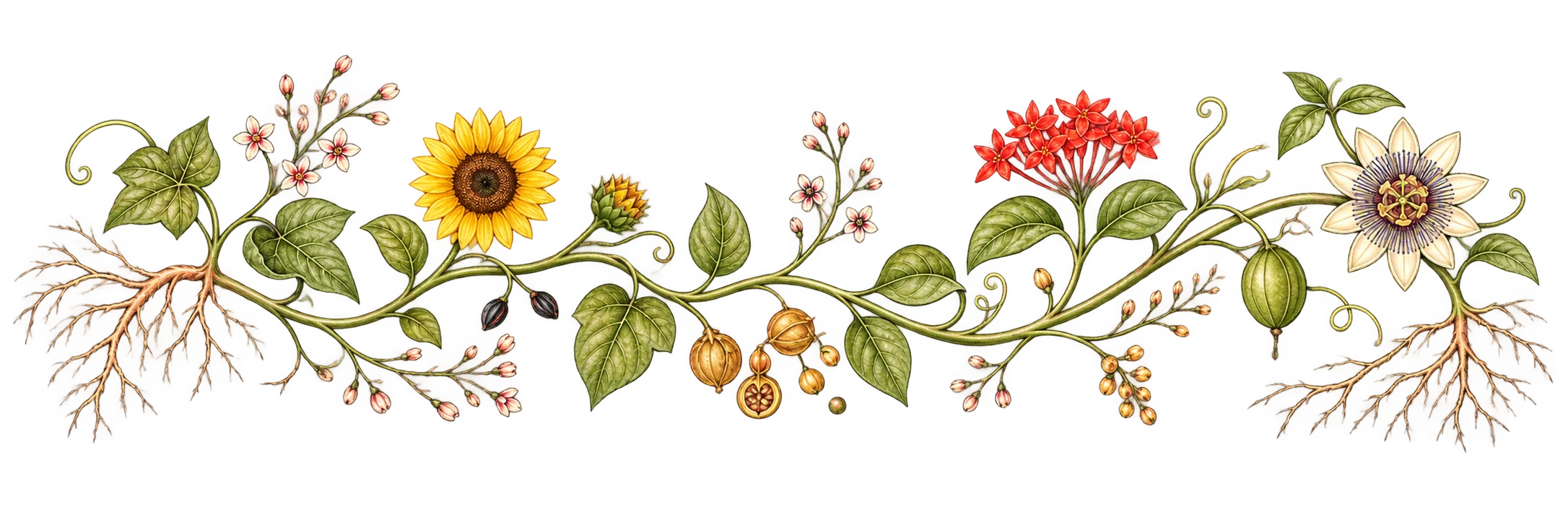
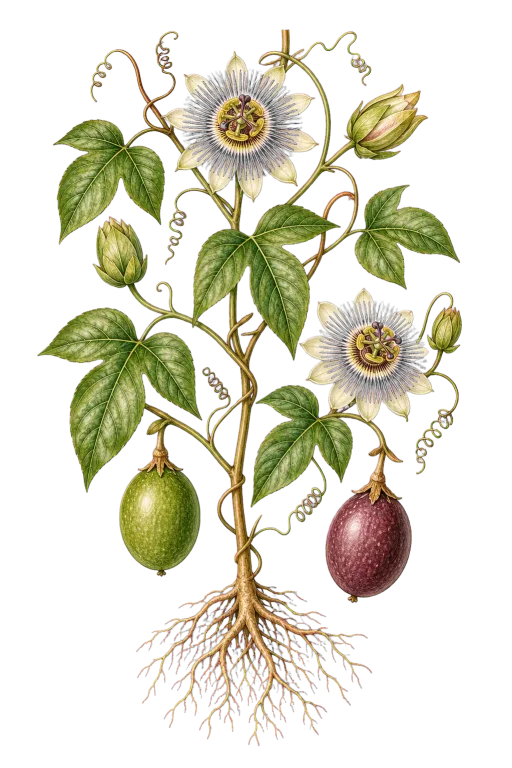
Mostly climbing vines with distinctive flowers having a complex fringe-like corona. Includes passionflower and granadilla (passion fruit).
Explore the species roster ↓Field identification keys
Compare several features together. These are typical family patterns; individual species can vary. Observe without tasting or handling unfamiliar plants.
- Stem cross-section
- Round
- Distinctive marker
- Flowers bear a distinctive fringed corona of thread-like filaments between petals and reproductive parts, raised on a central stalk (androgynophore).
Familiar members: Foetid Passion Flower · Krishna Phal · White Passion Flower · Cuban Buttercup · Small Passion Flower
Species in Passifloraceae
13 of 13 species
Native status is regional. Range tags distinguish Kew WCVP dataset matches from individual reviews. Pet-filter records report no known toxicity to cats and dogs; some sources cover a genus or cultivar. Review the source context. Missing values are excluded, and no rating establishes suitability to eat or freedom from other hazards.
| Botanical name | Common & regional names | Origin & reviewed pet status |
|---|---|---|
| Passiflora foetida | Foetid Passion Flower Common Passion Flower / Pop Vine / Running pop / Stinking passion flower / Tagua Passion Flower / Wild Maracuja
| Introduced: India ↗︎ Kew datasetKew WCVP dataset; accepted-name match. Dataset matching is separate from an individual regional review. Recorded worldwide native range: Trop. & Subtrop. America. |
| Passiflora edulis | Krishna Phal Passion fruit / Juice fruit / The edible passion / Edible passion flower / Granadilla / Maracuya / Purple granadilla / Parcha
+5 languages
| Introduced: India ↗︎ Kew datasetKew WCVP dataset; accepted-name match. Dataset matching is separate from an individual regional review. Recorded worldwide native range: Brazil to NE. Argentina. |
| Passiflora subpeltata | White Passion Flower | Introduced: India ↗︎ Kew datasetKew WCVP dataset; accepted-name match. Dataset matching is separate from an individual regional review. Recorded worldwide native range: Mexico to Venezuela. |
| Turnera subulata | Cuban Buttercup | Introduced: India ↗︎ Kew datasetKew WCVP dataset; accepted-name match. Dataset matching is separate from an individual regional review. Recorded worldwide native range: Windward Is. to S. Trop. America. |
| Passiflora suberosa | Small Passion Flower | Introduced: India ↗︎ Kew datasetKew WCVP dataset; accepted-name match. Dataset matching is separate from an individual regional review. Recorded worldwide native range: Trop. & Subtrop. America. |
| Adenia hondala | Kondala Hondala
+1 languages
| Native: India ↗︎ Kew datasetKew WCVP dataset; accepted-name match. Dataset matching is separate from an individual regional review. Recorded worldwide native range: S. India, Sri Lanka. |
| Passiflora vitifolia | Grapevine Leaf Passion Fruit
| Introduced: India ↗︎ Kew datasetKew WCVP dataset; accepted-name match. Dataset matching is separate from an individual regional review. Recorded worldwide native range: C. & S. Trop. America. |
| Passiflora tarminiana | Banana Passion Flower | Not listed native: India ↗︎ Kew datasetKew WCVP dataset; accepted-name match. Dataset matching is separate from an individual regional review. Recorded worldwide native range: S. Mexico to Venezuela and Peru. Not listed native does not establish introduction or absence from India. |
| Passiflora caerulea | Blue Passion Flower
| Introduced: India ↗︎ Kew datasetKew WCVP dataset; accepted-name match. Dataset matching is separate from an individual regional review. Recorded worldwide native range: Bolivia to Brazil and N. Argentina. Rating contextNC State: poison severity Medium poison parts leaves and stems problems list names children, cats, dogs, horses. NC State's 'Poisonous to Humans' rating is for people generally, not children specifically. ASPCA passion-flower page could not be loaded. |
| Passiflora holosericea | Velvet Leaf Passion Flower | Not listed native: India ↗︎ Kew datasetKew WCVP dataset; accepted-name match. Dataset matching is separate from an individual regional review. Recorded worldwide native range: W. & S. Mexico to Venezuela, Cuba. Not listed native does not establish introduction or absence from India. |
| Passiflora racemosa | Passionflower | Not listed native: India ↗︎ Kew datasetKew WCVP dataset; listed synonym of Passiflora princeps. Dataset matching is separate from an individual regional review. Recorded worldwide native range: SE. Brazil. Not listed native does not establish introduction or absence from India. |
| Adenia wightiana | Adenia wightiana | Native: India ↗︎ Kew datasetKew WCVP dataset; accepted-name match. Dataset matching is separate from an individual regional review. Recorded worldwide native range: E. Trop. Africa, S. India, Sri Lanka. |
| Passiflora calcarata | Passiflora calcarata | Introduced: India ↗︎ Kew datasetKew WCVP dataset; listed synonym of Passiflora subpeltata. Dataset matching is separate from an individual regional review. Recorded worldwide native range: Mexico to Venezuela. |
Alternate, often deeply lobed leaves on tendril climbers; flowers bear an elaborate fringe of thread-like filaments (the corona) between the petals and the reproductive parts, which sit raised on a central stalk above the flower's face.
The intricate corona and raised floral parts historically inspired Christian missionaries to read symbols of the Passion of Christ into the flower's structure, giving the genus its common name.
Which Passifloraceae species is this?
Answer what you can see and narrow it down to a single Passifloraceae species.
How to recognise the Passifloraceae family
- 01
Leaf arrangement: alternate
- 02
Leaf type: simple/lobed
- 03
Growth forms: vine/herb
- 04
Inflorescence: solitary axillary
- 05
Fruit: berry
To check whether a plant belongs to Passifloraceae, compare the leaf arrangement, leaf type, flower symmetry, fruit type, and one distinctive marker together. A single feature can mislead; the family pattern is the combination.
Learn the full family-identification methodFamilies that can look similar
Euphorbiaceae
Compare against Euphorbiaceae when the plant shares similar leaves, flowers, or fruit. Confirm by checking the full family pattern.
Compare EuphorbiaceaeClusiaceae
Compare against Clusiaceae when the plant shares similar leaves, flowers, or fruit. Confirm by checking the full family pattern.
Compare ClusiaceaeFlacourtiaceae
Compare against Flacourtiaceae when the plant shares similar leaves, flowers, or fruit. Confirm by checking the full family pattern.
Compare FlacourtiaceaeMalpighiaceae
Compare against Malpighiaceae when the plant shares similar leaves, flowers, or fruit. Confirm by checking the full family pattern.
Compare MalpighiaceaeMeet Passifloraceae in the field
Point your camera, explore possible matches and compare the field marks. Identification runs on your phone, offline and private.
Download SASYA — Free