Caricaceae family
Papaya family
1 catalogue species · Order Brassicales
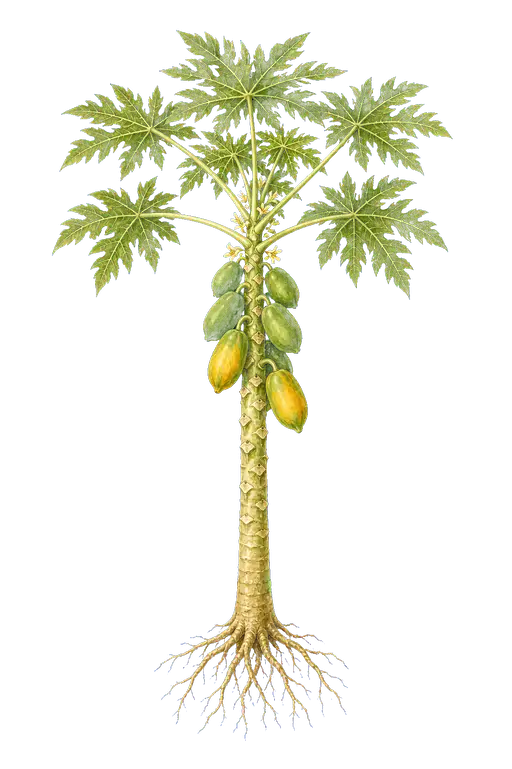
Small trees with hollow trunks and milky latex. Leaves palmate and clustered at apex. Papaya is the only common species.
Explore the species roster ↓Field identification keys
Compare several features together. These are typical family patterns; individual species can vary. Observe without tasting or handling unfamiliar plants.
- Stem cross-section
- Round
- Distinctive marker
- Trunk soft and largely hollow, not true dense wood; latex milky throughout; flowers usually unisexual on separate male and female trees.
Familiar members: Papita
Species in Caricaceae
1 of 1 species
Native status is regional. Range tags distinguish Kew WCVP dataset matches from individual reviews. Pet-filter records report no known toxicity to cats and dogs; some sources cover a genus or cultivar. Review the source context. Missing values are excluded, and no rating establishes suitability to eat or freedom from other hazards.
| Botanical name | Common & regional names | Origin & reviewed pet status |
|---|---|---|
| Carica papaya | Papita Papaya / Papas / Papaw tree
+6 languages
| Introduced: India ↗︎ Kew datasetKew WCVP dataset; accepted-name match. Dataset matching is separate from an individual regional review. Recorded worldwide native range: S. Mexico to Venezuela. |
Large, deeply palmately lobed leaves clustered at the top of a soft, hollow, unbranched trunk; milky latex oozes from any cut, and flowers are usually unisexual on separate male and female trees, the female ripening directly into the familiar large fleshy fruit.
The soft trunk is mostly hollow and non-woody, growing remarkably fast — a papaya can flower and fruit within its first year from seed, unusually quick for a tree-sized plant.
How to recognise the Caricaceae family
- 01
Leaf arrangement: alternate spiral
- 02
Leaf type: palmate lobed
- 03
Growth forms: tree/shrub
- 04
Inflorescence: cymose axillary
- 05
Fruit: large berry
To check whether a plant belongs to Caricaceae, compare the leaf arrangement, leaf type, flower symmetry, fruit type, and one distinctive marker together. A single feature can mislead; the family pattern is the combination.
Learn the full family-identification methodFamilies that can look similar
Capparaceae
Compare against Capparaceae when the plant shares similar leaves, flowers, or fruit. Confirm by checking the full family pattern.
Compare CapparaceaeBrassicaceae
Compare against Brassicaceae when the plant shares similar leaves, flowers, or fruit. Confirm by checking the full family pattern.
Compare BrassicaceaeMoringaceae
Compare against Moringaceae when the plant shares similar leaves, flowers, or fruit. Confirm by checking the full family pattern.
Compare MoringaceaeSalvadoraceae
Compare against Salvadoraceae when the plant shares similar leaves, flowers, or fruit. Confirm by checking the full family pattern.
Compare SalvadoraceaeMeet Caricaceae in the field
Point your camera, explore possible matches and compare the field marks. Identification runs on your phone, offline and private.
Download SASYA — Free