Thymelaeaceae
Daphne/Agarwood family
Trees and shrubs with very fibrous bark. No petals; calyx is petaloid. Includes agarwood (Aquilaria), daphne, and thymelaea.
Browse all 2 species ↓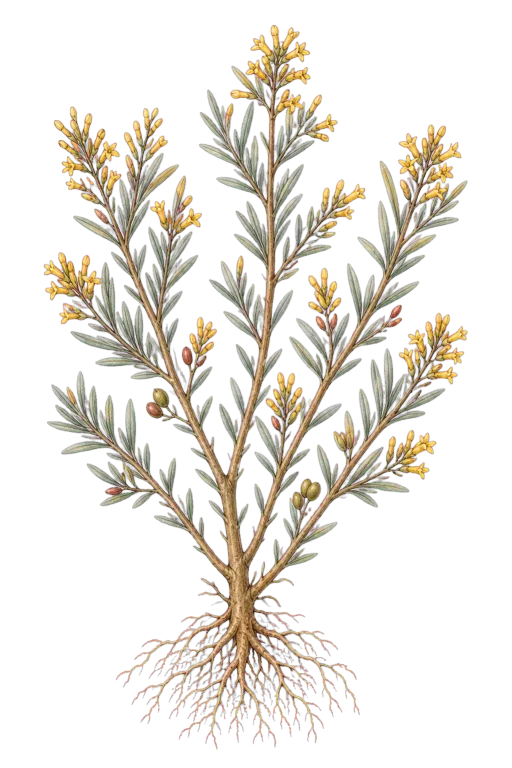
Trees and shrubs with unusually fibrous, tough bark that resists tearing; flowers lack true petals entirely, their colour coming from a petal-like calyx tube instead, ripening into a small drupe or nut.
One member (Aquilaria) produces fragrant, resin-infused agarwood only in response to fungal infection or injury, making naturally formed agarwood among the most valuable woods in the world by weight.
Which Thymelaeaceae species is this?
Answer what you can see and narrow it down to a single Thymelaeaceae species.
How to recognise the Thymelaeaceae family
- 01
Leaf arrangement: alternate
- 02
Leaf type: simple
- 03
Growth forms: shrub/tree
- 04
Inflorescence: head/raceme/cymose
- 05
Fruit: drupe/berry
To check whether a plant belongs to Thymelaeaceae, compare the leaf arrangement, leaf type, flower symmetry, fruit type, and one distinctive marker together. A single feature can mislead; the family pattern is the combination.
Learn the full family-identification methodNotable members
Families that can look similar
Malvaceae
Compare against Malvaceae when the plant shares similar leaves, flowers, or fruit. Confirm by checking the full family pattern.
Compare MalvaceaeSterculiaceae
Compare against Sterculiaceae when the plant shares similar leaves, flowers, or fruit. Confirm by checking the full family pattern.
Compare SterculiaceaeTiliaceae
Compare against Tiliaceae when the plant shares similar leaves, flowers, or fruit. Confirm by checking the full family pattern.
Compare TiliaceaeDipterocarpaceae
Compare against Dipterocarpaceae when the plant shares similar leaves, flowers, or fruit. Confirm by checking the full family pattern.
Compare DipterocarpaceaeAll 2 species in THYMELAEACEAE
Identify any Thymelaeaceae plant in seconds
Point your camera and SASYA names the species on-device — offline and private.
Download SASYA — Free