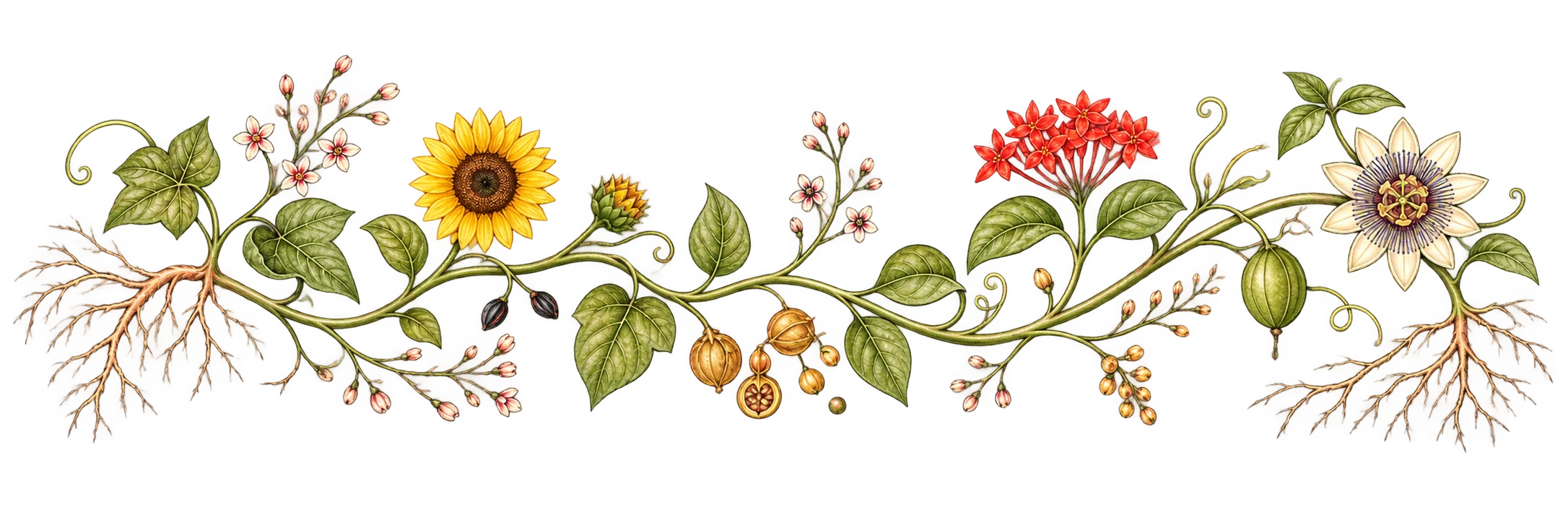
Pedaliaceae family
Pedalium Or Sesame Family
6 catalogue species · Order Lamiales
The Pedaliaceae family (Pedalium Or Sesame Family) is a botanical family placed in the order Lamiales. In the SASYA catalogue it spans 6 species across 3 genera. Its members are predominantly herbs. Well-represented genera include Sesamum, Martynia and Pedalium. Several members are valued in traditional medicine. Familiar examples include Devils'claw, Teeth dropping Plant and Wingseed Sesame.
Explore the species roster ↓Field identification keys
Compare several features together. These are typical family patterns; individual species can vary. Observe without tasting or handling unfamiliar plants.
- Stem cross-section
- Round
- Distinctive marker
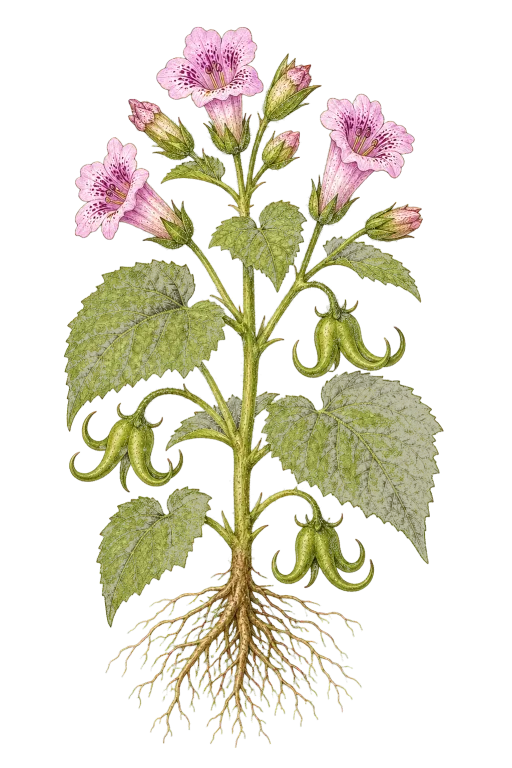
- Fruit often armed with hooked spines or horn-like projections; leaves and stems distinctly mucilaginous when crushed.
Familiar members: Til · Ulat-Kanta · Bada Gokharu · Wingseed Sesame · Peerel
Species in Pedaliaceae
6 of 6 species
Native status is regional. Range tags distinguish Kew WCVP dataset matches from individual reviews. Pet-filter records report no known toxicity to cats and dogs; some sources cover a genus or cultivar. Review the source context. Missing values are excluded, and no rating establishes suitability to eat or freedom from other hazards.
| Botanical name | Common & regional names | Origin & reviewed pet status |
|---|---|---|
| Sesamum indicum | Til Sesame / Gingelly Oil / Gingelly / Beniseed / Simsim
+7 languages
| Native: Assam, India, West Himalaya ↗︎ Kew datasetKew WCVP dataset; accepted-name match. Dataset matching is separate from an individual regional review. Recorded worldwide native range: Indian Subcontinent. |
| Martynia annua | Ulat-Kanta Devils'claw / Tiger claw / Snake's head
+4 languages
| Introduced: India ↗︎ Kew datasetKew WCVP dataset; accepted-name match. Dataset matching is separate from an individual regional review. Recorded worldwide native range: Mexico to C. America, Caribbean. |
| Pedalium murex | Bada Gokharu Teeth dropping Plant / Large caltrops / Bara Gokhuru
+4 languages
| Native: India ↗︎ Kew datasetKew WCVP dataset; accepted-name match. Dataset matching is separate from an individual regional review. Recorded worldwide native range: W. Trop. Africa to Eritrea and N. Mozambique, Comoros, Madagascar, Pakistan to Sri Lanka, Jawa. |
| Sesamum alatum | Wingseed Sesame | Introduced: India ↗︎ Kew datasetKew WCVP dataset; accepted-name match. Dataset matching is separate from an individual regional review. Recorded worldwide native range: Dry Africa. |
| Sesamum laciniatum | Peerel Indian Sesame Oil Plant
| Native: Assam, India ↗︎ Kew datasetKew WCVP dataset; listed synonym of Sesamum prostratum. Dataset matching is separate from an individual regional review. Recorded worldwide native range: India to Assam, E. Sri Lanka. |
| Sesamum mulayanum | Safed Til Sesame
+2 languages
| Native: Assam, India, West Himalaya ↗︎ Kew datasetKew WCVP dataset; listed synonym of Sesamum indicum. Dataset matching is separate from an individual regional review. Recorded worldwide native range: Indian Subcontinent. |
Opposite, often glandular-hairy leaves on herbs with mucilaginous sap; bilaterally symmetrical, tubular flowers resemble small foxgloves and ripen into a distinctive fruit armed with hooked spines or horns.
Sesame, the family's best-known member, packs its seeds with unusually stable, oxidation-resistant oil — one reason sesame oil has remained a staple cooking and preservation oil for millennia.
Which Pedaliaceae species is this?
Answer what you can see and narrow it down to a single Pedaliaceae species.
To check whether a plant belongs to Pedaliaceae, compare the leaf arrangement, leaf type, flower symmetry, fruit type, and one distinctive marker together. A single feature can mislead; the family pattern is the combination.
Learn the full family-identification methodFamilies that can look similar
Acanthaceae
Compare against Acanthaceae when the plant shares similar leaves, flowers, or fruit. Confirm by checking the full family pattern.
Compare AcanthaceaeLamiaceae
Compare against Lamiaceae when the plant shares similar leaves, flowers, or fruit. Confirm by checking the full family pattern.
Compare LamiaceaeVerbenaceae
Compare against Verbenaceae when the plant shares similar leaves, flowers, or fruit. Confirm by checking the full family pattern.
Compare VerbenaceaeScrophulariaceae
Compare against Scrophulariaceae when the plant shares similar leaves, flowers, or fruit. Confirm by checking the full family pattern.
Compare ScrophulariaceaeMeet Pedaliaceae in the field
Point your camera, explore possible matches and compare the field marks. Identification runs on your phone, offline and private.
Download SASYA — Free