Papaveraceae family
Poppy Family
3 catalogue species · Order Ranunculales
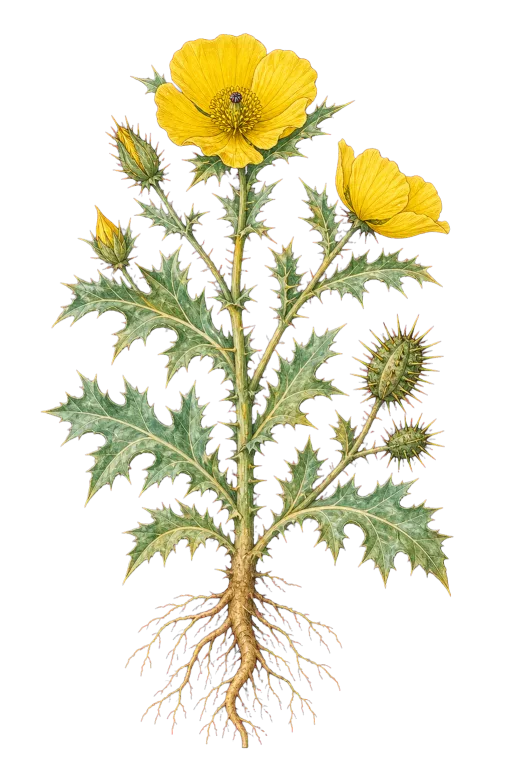
The Papaveraceae family (Poppy Family) is a botanical family placed in the order Ranunculales. In the SASYA catalogue it spans 3 species across 3 genera. Its members are predominantly herbs. Well-represented genera include Argemone, Eschscholzia and Papaver. Several members are valued in traditional medicine. Familiar examples include Broad-leaved Sorel, California Poppy and common poppy.
Explore the species roster ↓Field identification keys
Compare several features together. These are typical family patterns; individual species can vary. Observe without tasting or handling unfamiliar plants.
- Stem cross-section
- Round
- Leaf type
- Compound
- Distinctive marker
- Capsule releases seeds through small pores beneath a flat, disc-like stigma cap; latex carries potent alkaloids.
Familiar members: Satyanashi · Common Poppy · California Poppy
Species in Papaveraceae
3 of 3 species
Native status is regional. Range tags distinguish Kew WCVP dataset matches from individual reviews. Pet-filter records report no known toxicity to cats and dogs; some sources cover a genus or cultivar. Review the source context. Missing values are excluded, and no rating establishes suitability to eat or freedom from other hazards.
| Botanical name | Common & regional names | Origin & reviewed pet status |
|---|---|---|
| Argemone mexicana | Satyanashi Broad-leaved Sorel / Prickly Poppy / Mexican Poppy / Yellow mexican poppy
+8 languages
| Introduced: India ↗︎ Kew datasetKew WCVP dataset; accepted-name match. Dataset matching is separate from an individual regional review. Recorded worldwide native range: C. Mexico to Honduras. |
| Papaver rhoeas | Common Poppy
| Native: West Himalaya ↗︎ Kew datasetKew WCVP dataset; accepted-name match. Dataset matching is separate from an individual regional review. Recorded worldwide native range: Macaronesia, Europe to Medit. and W. Himalaya. |
| Eschscholzia californica | California Poppy | Introduced: India ↗︎ Kew datasetKew WCVP dataset; accepted-name match. Dataset matching is separate from an individual regional review. Recorded worldwide native range: W. & SC. U.S.A. to N. Mexico. |
Deeply lobed or dissected leaves on herbs oozing white, yellow, or orange latex when cut; large, delicate, crinkled petals fall quickly after opening, and numerous stamens surround an ovary that ripens into a capsule releasing seeds through pores beneath a flat, disc-like stigma cap.
Latex throughout the family carries potent alkaloids — opium poppy's latex is the source of morphine and codeine, among the most significant plant-derived medicines ever discovered.
Which Papaveraceae species is this?
Answer what you can see and narrow it down to a single Papaveraceae species.
To check whether a plant belongs to Papaveraceae, compare the leaf arrangement, leaf type, flower symmetry, fruit type, and one distinctive marker together. A single feature can mislead; the family pattern is the combination.
Learn the full family-identification methodTypical leaf characters
- ArrangementVariable
 TypeCompound
- MarginVariable
- VenationVariable
Characters typical of the family — individual species can vary.
Typical flower & fruit
- Flower symmetryVariable
- InflorescenceCyme
- FruitVariable
Typical of the family — flowering plants only; species can vary.
Families that can look similar
Fumariaceae
Compare against Fumariaceae when the plant shares similar leaves, flowers, or fruit. Confirm by checking the full family pattern.
Compare FumariaceaeRanunculaceae
Compare against Ranunculaceae when the plant shares similar leaves, flowers, or fruit. Confirm by checking the full family pattern.
Compare RanunculaceaeMenispermaceae
Compare against Menispermaceae when the plant shares similar leaves, flowers, or fruit. Confirm by checking the full family pattern.
Compare MenispermaceaeBerberidaceae
Compare against Berberidaceae when the plant shares similar leaves, flowers, or fruit. Confirm by checking the full family pattern.
Compare BerberidaceaeMeet Papaveraceae in the field
Point your camera, explore possible matches and compare the field marks. Identification runs on your phone, offline and private.
Download SASYA — Free