Lentibulariaceae family
Bladderwort Family
17 catalogue species · Order Lamiales
The Lentibulariaceae family (Bladderwort Family) is a botanical family placed in the order Lamiales. In the SASYA catalogue it spans 17 species. Its members are predominantly herbs. Several members are valued in traditional medicine. Familiar examples include White-Blue Bladderwort, Bladderwort and Babu Bladderwort.
Explore the species roster ↓Field identification keys
Compare several features together. These are typical family patterns; individual species can vary. Observe without tasting or handling unfamiliar plants.
- Stem cross-section
- Round
- Leaf arrangement
- Basal
- Distinctive marker
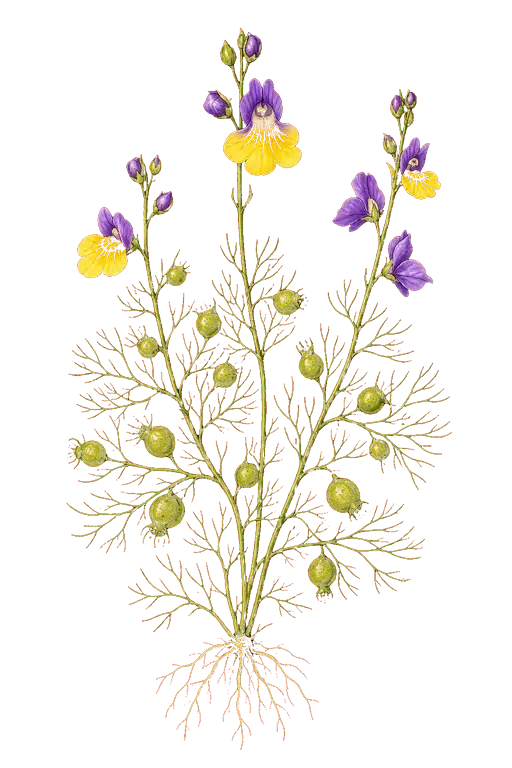
- Carnivorous — bladder-like suction traps (Utricularia) or sticky glandular leaves (Pinguicula) capture tiny prey.
Familiar members: Striped Bladderwort · Reticulata · Blue Bladderwort · Bifid Bladder-Wort · Lazuli Bladderwort
Species in Lentibulariaceae
17 of 17 species
Native status is regional. Range tags distinguish Kew WCVP dataset matches from individual reviews. Pet-filter records report no known toxicity to cats and dogs; some sources cover a genus or cultivar. Review the source context. Missing values are excluded, and no rating establishes suitability to eat or freedom from other hazards.
| Botanical name | Common & regional names | Origin & reviewed pet status |
|---|---|---|
| Utricularia striatula | Striped Bladderwort
| Native: Andaman Is., Assam, India ↗︎ Kew datasetKew WCVP dataset; accepted-name match. Dataset matching is separate from an individual regional review. Recorded worldwide native range: Trop. Africa, S. Arabian Pen. Trop. & Subtrop. Asia. |
| Utricularia reticulata | Reticulata net-veined bladderwort
| Native: India ↗︎ Range reviewIndividually reviewed range. Native status applies to the stated region. |
| Utricularia caerulea | Blue Bladderwort
| Native: Andaman Is., Assam, India ↗︎ Kew datasetKew WCVP dataset; accepted-name match. Dataset matching is separate from an individual regional review. Recorded worldwide native range: N. Madagascar, S. Russian Far East to Trop. & Subtrop. Asia, N. & E. Australia. |
| Utricularia bifida | Bifid Bladder-Wort
| Native: Assam, India ↗︎ Kew datasetKew WCVP dataset; accepted-name match. Dataset matching is separate from an individual regional review. Recorded worldwide native range: Trop. & Subtrop. Asia to NW. Pacific. |
| Utricularia lazulina | Lazuli Bladderwort | Native: India ↗︎ Kew datasetKew WCVP dataset; accepted-name match. Dataset matching is separate from an individual regional review. Recorded worldwide native range: SW. India. |
| Utricularia graminifolia | Khur Papni Grass-leaved Bladder-wort
| Native: India ↗︎ Kew datasetKew WCVP dataset; accepted-name match. Dataset matching is separate from an individual regional review. Recorded worldwide native range: Sri Lanka, India to China (Yunnan, Guangdong, S. Fujian). |
| Utricularia scandens | Climbing Bladderwort | Native: India ↗︎ Kew datasetKew WCVP dataset; accepted-name match. Dataset matching is separate from an individual regional review. Recorded worldwide native range: Trop. & S. Africa, Madagascar, Indian Subcontinent to China (S. Yunnan, SW. Guizhou) and Pen. Malaysia, New Guinea. |
| Utricularia praeterita | Tiny Bladderwort | Native: India ↗︎ Kew datasetKew WCVP dataset; accepted-name match. Dataset matching is separate from an individual regional review. Recorded worldwide native range: W. India. |
| Utricularia exoleta | Humped Bladderwort | Native: Assam, India, Nicobar Is. ↗︎ Kew datasetKew WCVP dataset; listed synonym of Utricularia gibba. Dataset matching is separate from an individual regional review. Recorded worldwide native range: Trop. & Subtrop. Old World, America. |
| Utricularia babui | Babu Jathari Babu Bladderwort
| Native: India ↗︎ Kew datasetKew WCVP dataset; accepted-name match. Dataset matching is separate from an individual regional review. Recorded worldwide native range: W. India, N. Thailand. |
| Utricularia stellaris | Star Bladderwort | Native: Assam, India ↗︎ Kew datasetKew WCVP dataset; accepted-name match. Dataset matching is separate from an individual regional review. Recorded worldwide native range: Africa, Indian Subcontinent to Indo-China, N. Australia. |
| Utricularia uliginosa | Asian Bladderwort | Native: India, Nicobar Is. ↗︎ Kew datasetKew WCVP dataset; accepted-name match. Dataset matching is separate from an individual regional review. Recorded worldwide native range: Trop. & Subtrop. Asia to NW. Pacific. |
| Utricularia albocaerulea | White-Blue Bladderwort | Native: India ↗︎ Kew datasetKew WCVP dataset; accepted-name match. Dataset matching is separate from an individual regional review. Recorded worldwide native range: India (SW. Maharashtra). |
| Utricularia australis | Bladderwort
| Not listed native: India ↗︎ Kew datasetKew WCVP dataset; accepted-name match. Dataset matching is separate from an individual regional review. Recorded worldwide native range: Australia, New Zealand. Not listed native does not establish introduction or absence from India. |
| Utricularia janarthanamii | Tiny Blue Bladderwort | Native: India ↗︎ Kew datasetKew WCVP dataset; accepted-name match. Dataset matching is separate from an individual regional review. Recorded worldwide native range: India (Maharashtra). |
| Utricularia purpurascens | Khur Papni Grass Leaved Bladderwort
| Native: India ↗︎ Kew datasetKew WCVP dataset; listed synonym of Utricularia graminifolia. Dataset matching is separate from an individual regional review. Recorded worldwide native range: Sri Lanka, India to China (Yunnan, Guangdong, S. Fujian). |
| Utricularia arcuata | Utricularia arcuata | Native: India ↗︎ Kew datasetKew WCVP dataset; accepted-name match. Dataset matching is separate from an individual regional review. Recorded worldwide native range: India. |
Rootless or nearly rootless aquatic and marsh herbs that trap tiny prey in bladder-like suction traps (Utricularia) or on sticky glandular leaves (Pinguicula); bilaterally symmetrical flowers with a spurred, two-lipped corolla rise above the water or mud on a slender stalk.
One of the few fully carnivorous plant families — its underwater bladder traps are among the fastest-moving structures known in plants, snapping shut in under a millisecond to suck in prey.
Which Lentibulariaceae species is this?
Answer what you can see and narrow it down to a single Lentibulariaceae species.
To check whether a plant belongs to Lentibulariaceae, compare the leaf arrangement, leaf type, flower symmetry, fruit type, and one distinctive marker together. A single feature can mislead; the family pattern is the combination.
Learn the full family-identification methodTypical leaf characters
 ArrangementBasal
- TypeVariable
- MarginVariable
- VenationVariable
Characters typical of the family — individual species can vary.
Families that can look similar
Acanthaceae
Compare against Acanthaceae when the plant shares similar leaves, flowers, or fruit. Confirm by checking the full family pattern.
Compare AcanthaceaeLamiaceae
Compare against Lamiaceae when the plant shares similar leaves, flowers, or fruit. Confirm by checking the full family pattern.
Compare LamiaceaeVerbenaceae
Compare against Verbenaceae when the plant shares similar leaves, flowers, or fruit. Confirm by checking the full family pattern.
Compare VerbenaceaeScrophulariaceae
Compare against Scrophulariaceae when the plant shares similar leaves, flowers, or fruit. Confirm by checking the full family pattern.
Compare ScrophulariaceaeMeet Lentibulariaceae in the field
Point your camera, explore possible matches and compare the field marks. Identification runs on your phone, offline and private.
Download SASYA — Free