
Money plant leaves turning yellow? Follow the clues.
Money plant leaves turning yellow? First check whether the colour is new. Golden pothos can have yellow markings naturally. If a previously green leaf is changing, inspect the pot's moisture and drainage, then look at recent changes in light and care before adding water or fertiliser.
A yellow leaf can make the watering can feel like an emergency tool. Pause for a closer look: one old leaf, an established golden pattern and several newly yellow leaves are three different starting points. This guide concerns potted pothos, Epipremnum aureum, the trailing money plant familiar in Indian homes.
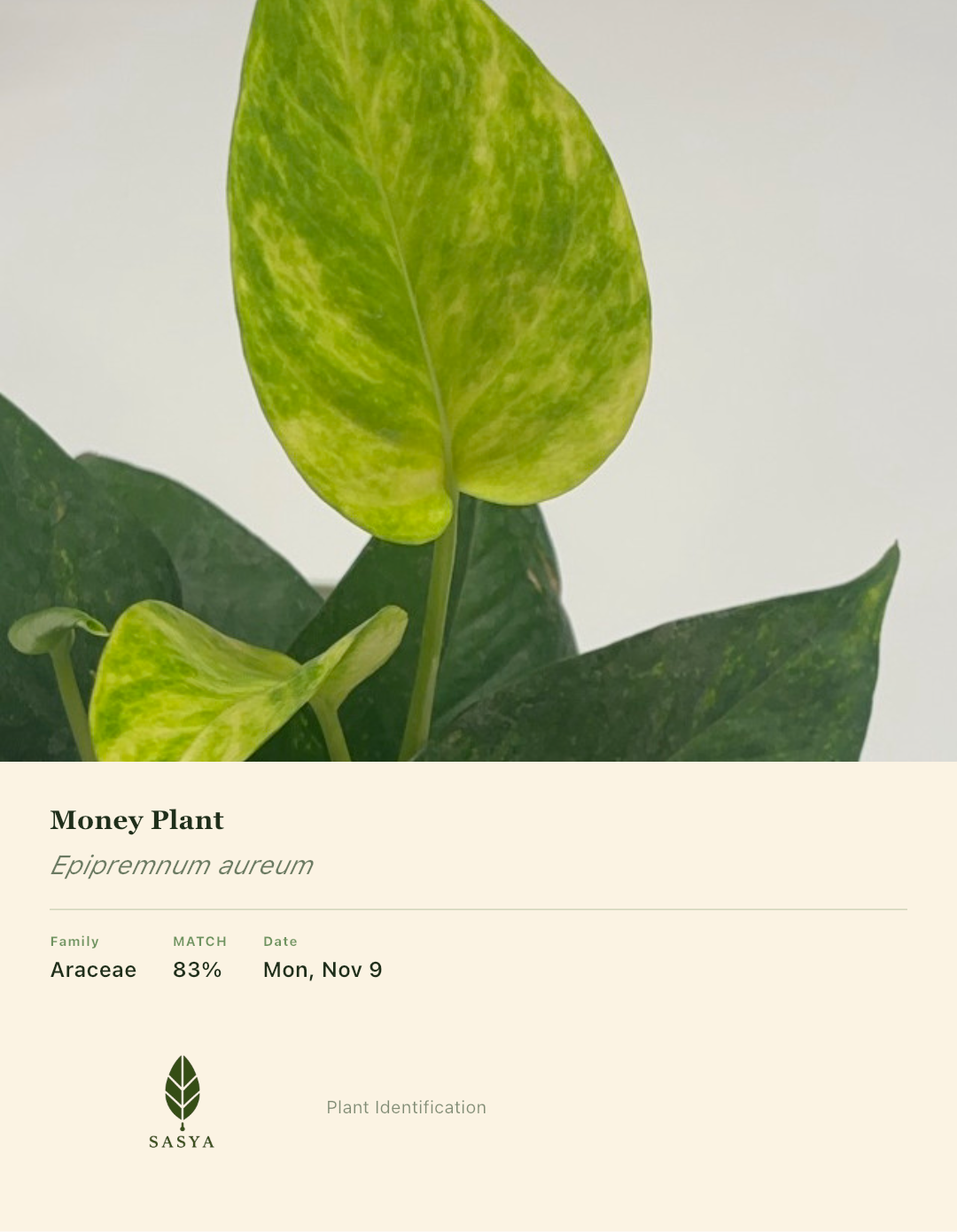
Is it yellowing, or golden pothos being golden?
Look at an older photograph of the same leaf or vine. Did the pale markings already exist? Is a patch of green now losing colour? Compare several leaves rather than deciding from the brightest one in a camera preview.
Golden pothos has naturally patterned foliage. A 2010 study of its variegation investigated chlorophyll-related differences in green and pale-yellow plant material. It helps explain why yellow colour is not, by itself, evidence that a plant needs fertiliser. It does not establish what caused a new change on your plant.
The original identification card above shows a plant-name suggestion, not a diagnosis. Its 83% match is not a probability that a leaf is healthy or diseased. If your “money plant” has a woody trunk or round, coin-shaped leaves, confirm its identity first; the name is used for different plants.
Follow the clues before choosing a fix
Start with the whole plant, then inspect the affected vine and pot. This table helps choose a check; it cannot diagnose a cause from a leaf's colour.
| What you notice | What to check next | A useful first action |
|---|---|---|
| The same gold pattern appears in older photos | Whether any previously green tissue has changed | Observe rather than treating the colour alone |
| One older leaf changes while other growth looks normal | Whether new damage appears elsewhere | Photograph the vine and compare at the next check |
| Several leaves change and the mix stays wet | Drainage holes, trapped water and the plant's base | Empty standing water and reassess before watering again |
| Dry mix with wilting or dry edges | Whether water is reaching the root ball | Water the mix and let excess drain freely |
| Damage follows a move to stronger sun | The timing and extent of the light change | Return to filtered light; avoid another abrupt move |
| Wilting continues despite wet mix, or the base softens | Root condition and the rest of the plant | Seek horticultural advice if damage is spreading |
Wisconsin Extension's pothos guidance describes natural loss of older leaves as well as watering-related problems. A single leaf can therefore deserve observation rather than an immediate treatment. Symptoms that spread deserve a closer investigation.
Check the pot, not the calendar
An exposed balcony in the rain and a sheltered window in the same building can give two pots very different conditions. “Water twice a week” leaves that out.
Check the mix below its surface, feel the pot's weight and look inside any decorative outer pot for trapped water. Make sure the drainage outlet is open. A dry-looking surface does not tell you everything about moisture deeper in the pot. Record what you find before deciding whether to add water.
There is relevant Indian research here, but it needs its context. At ICAR's Directorate of Floricultural Research in Pune, researchers compared 11 growing media over nine months under 50% shade. The published experiment studied foliage-plant growth, not remedies for yellow leaves. Its specific conditions are a reminder to examine your own pot; its experimental mixtures are not a household recipe.
If the plant remains wilted in wet mix, or its base is soft, checking only the leaf misses part of the story. The RHS houseplant guide recommends examining root condition when investigating damage. Soft, rotted roots are a reason to reassess growing conditions, not proof of a named pathogen. Avoid repeatedly unpotting an otherwise stable plant.
What changed before the leaf changed?
Think back to a move, repotting, a new feed or a change in watering. A sequence is more useful than a guess: “moved into afternoon sun, then patches appeared” gives you something specific to investigate.
Pothos generally does well in filtered light; sudden exposure to stronger sun can cause damage. University of Minnesota guidance cautions against abrupt light changes. Move gradually rather than sending a struggling indoor plant straight into strong balcony sun.
Cold exposure is another question when the setting fits. In a controlled study in China, pothos held at 1°C, compared with a 20°C control, developed yellowing and other damage. Those are severe experimental conditions. They do not establish that an ordinary air-conditioned room, or November anywhere in India, caused your plant's symptoms.
Where a plant-check app can help
Use an app to organise an investigation, while keeping your own observations in view. In SASYA's guided Diagnose mode, you start with a leaf or stem, review suggested signs and answer follow-up questions. Watering, light or repotting questions can help explain what was seen; their order depends on the observations.
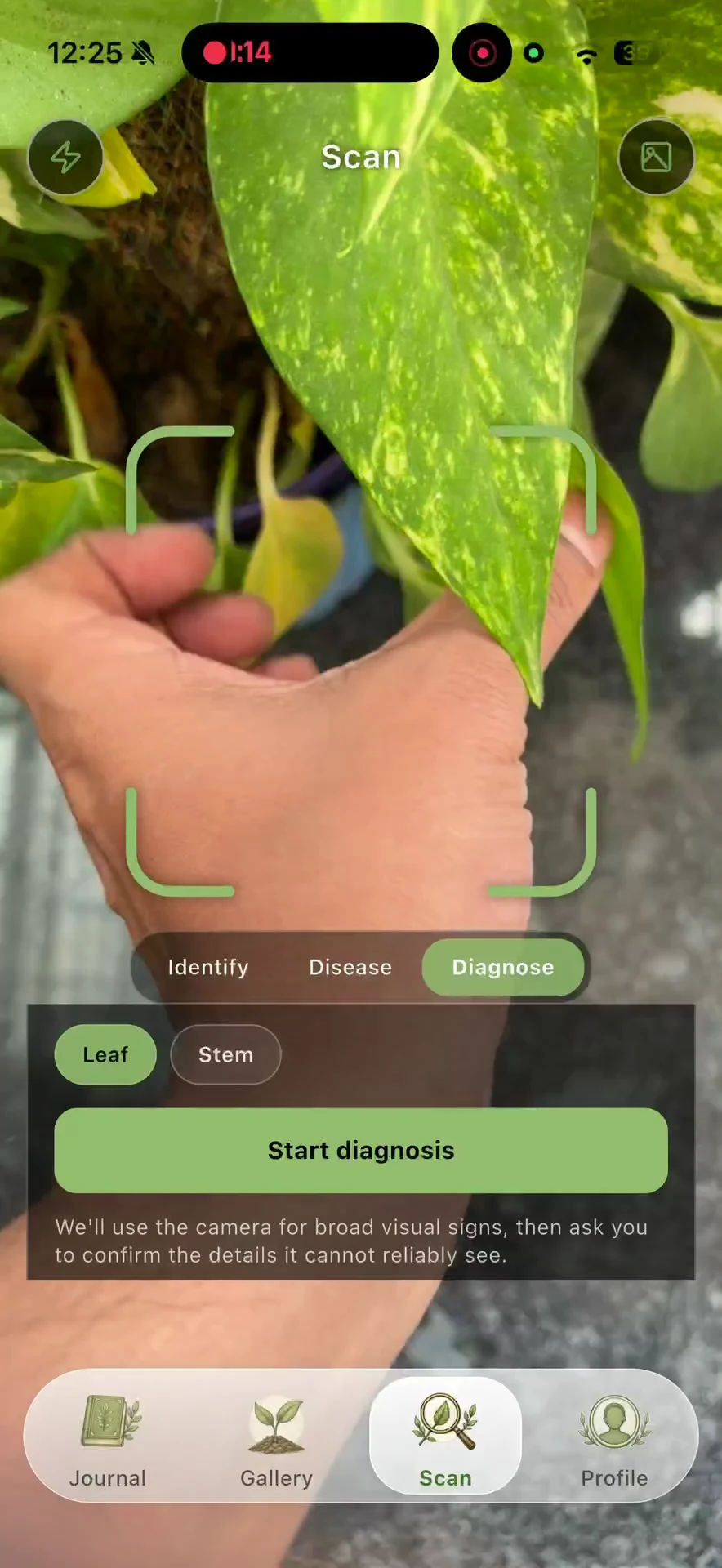
An original screenshot from our app walkthrough. Existing colour patterns are visible, but the recording does not establish new yellowing or its cause.
The recording used here contains multiple checks and plants. It did not establish a confirmed cause on the money plant. A later check ended with “More observations needed.” That is an inconclusive result, not a diagnosis to turn into a treatment recommendation.
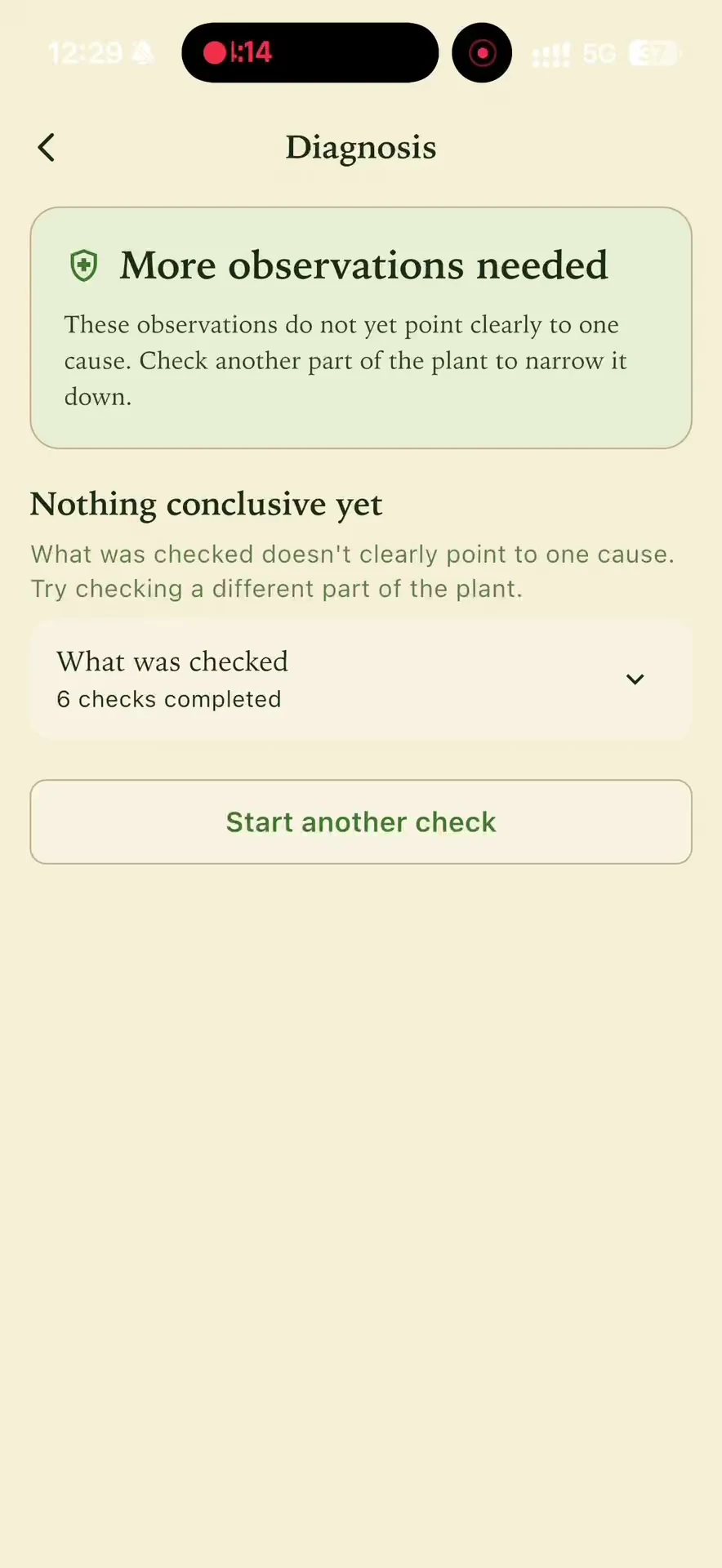
An actual result from a later check in the recording. These screenshots illustrate the interface; they are not before-and-after treatment evidence.
The camera cannot measure moisture inside the pot or inspect hidden roots. If a suggestion disagrees with what you can see, keep the cause open and record the disagreement. SASYA's journal can hold notes for comparison later; an app suggestion is a starting point for checking, not biological confirmation.
An old observation, a practical habit
Yellow leaves were being discussed long before phone cameras. In Vanaspati (University of Calcutta, 1927), botanist Girija Prasanna Majumdar's survey of Indian texts records yellowing alongside conditions such as heat, cold and excessive rain on printed page 48.
The useful connection is a habit: look at the symptom and its surroundings together. The historical passage does not establish a pothos treatment. The care checks here draw on the modern sources linked above; historical preparations are not presented as remedies.
Before adding fertiliser or a home remedy
A colour change alone does not establish a nutrient deficiency. First record moisture, drainage, light history and visible pests. Adding several products at once makes it harder to tell what helped or caused further damage.
Keep a small record for the next check:
- Photograph the whole plant and the same affected leaf or vine.
- Note which leaves changed and whether new damage is appearing.
- Record moisture, trapped water and recent care changes.
- Write down any action you take, with its date.
- Compare the same views later, rather than two differently framed photographs.
There is no seven-day recovery promise here. If several plants become affected, stems collapse or damage progresses rapidly, take the photos and care history to a local horticultural adviser or plant-diagnostic service. For a different plant, our tulsi black-leaf guide starts with another useful distinction: coating, normal colour or damaged tissue.
By SASYA. Prepared 12 November 2026. A source-based guide for soil-grown potted pothos, with original app-walkthrough screenshots. It reports neither a confirmed diagnosis nor a successful treatment trial. Water-grown cuttings need a separate assessment.
General guidance for home growers — always follow product labels and local regulations before using any treatment.
Check your plant with SASYA
Explore possible plant matches, check visible leaf symptoms and keep private field notes — on-device, offline and free.