Caprifoliaceae
Honeysuckle family
Shrubs and vines with tubular often fragrant flowers. Includes honeysuckle, elder, and viburnum.
Browse all 5 species ↓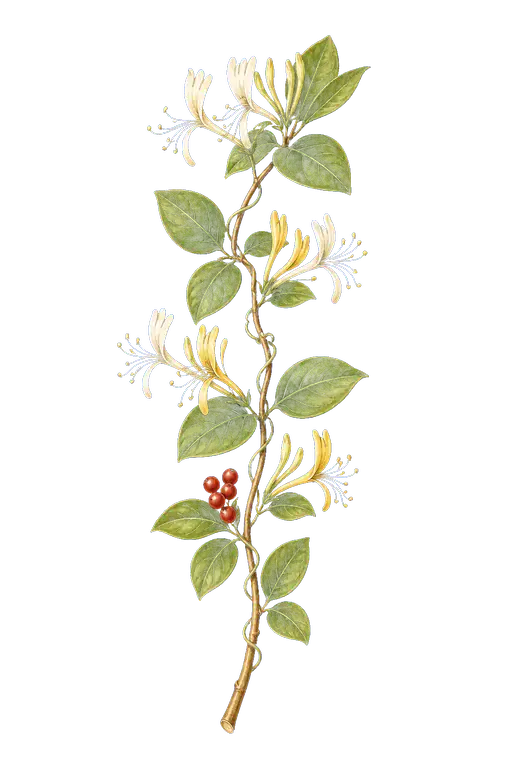
Opposite leaves on shrubs and twining vines; tubular, often strongly fragrant flowers open mostly toward evening to attract moth pollinators, ripening into a berry.
Many species release their strongest fragrance only after dusk, timed precisely to when night-flying moths are most active — a floral scent clock rather than a constant perfume.
Which Caprifoliaceae species is this?
Answer what you can see and narrow it down to a single Caprifoliaceae species.
How to recognise the Caprifoliaceae family
- 01
Leaf arrangement: opposite
- 02
Leaf type: simple/pinnate
- 03
Growth forms: shrub/vine
- 04
Inflorescence: cymose/panicle
- 05
Fruit: berry/drupe
To check whether a plant belongs to Caprifoliaceae, compare the leaf arrangement, leaf type, flower symmetry, fruit type, and one distinctive marker together. A single feature can mislead; the family pattern is the combination.
Learn the full family-identification methodTypical leaf characters
- ArrangementOpposite
- TypeVariable
- MarginVariable
- VenationVariable
Characters typical of the family — individual species can vary.
Typical flower & fruit
- Flower symmetryVariable
- InflorescenceVariable
- FruitDrupe
Typical of the family — flowering plants only; species can vary.
Notable members
Families that can look similar
Verbenaceae
Compare against Verbenaceae when the plant shares similar leaves, flowers, or fruit. Confirm by checking the full family pattern.
Compare VerbenaceaeOleaceae
Compare against Oleaceae when the plant shares similar leaves, flowers, or fruit. Confirm by checking the full family pattern.
Compare OleaceaeChloranthaceae
Compare against Chloranthaceae when the plant shares similar leaves, flowers, or fruit. Confirm by checking the full family pattern.
Compare ChloranthaceaeValerianaceae
Compare against Valerianaceae when the plant shares similar leaves, flowers, or fruit. Confirm by checking the full family pattern.
Compare ValerianaceaeAll 5 species in CAPRIFOLIACEAE
Identify any Caprifoliaceae plant in seconds
Point your camera and SASYA names the species on-device — offline and private.
Download SASYA — Free