
Looking for Rare Plants in Kodaikanal, and Finding Mostly Visitors
On a holiday in Kodaikanal I went looking for rare plants. Most of what I found was introduced, from gorse and Crofton weed to dawn flower. What each one is, and why the Palani Hills grasslands are shrinking.
My wife and I went up to Kodaikanal for a holiday. The weather was lovely. I had been there once before, and I remembered the flowers differently. This time I had SASYA open on my phone, and a quiet hope of finding something rare.
At first, everything looked beautiful. Yellow gorse beside the paths, blue morning glories spilling over hedges, pink fuchsias hanging along the trail. But after a while the beauty started to feel repetitive: the same few plants, again and again. They were pretty, but decorative, more like a garden that had escaped than a wild hillside. The variety I remembered seemed to be missing, and every plant I hoped might be rare turned out to be common.
So I started reading about the ones I kept finding. Most of them aren't from here at all.
I can't tell you what changed between my two visits. One person's memory isn't data. But ecologists and the Tamil Nadu Forest Department have been measuring change in these hills for decades, and what they describe matches what I felt.
This isn't a survey. It's a holiday, a phone, and ten plants I picked for this post, not a random sample. Of those ten, nine are not native to the Western Ghats.
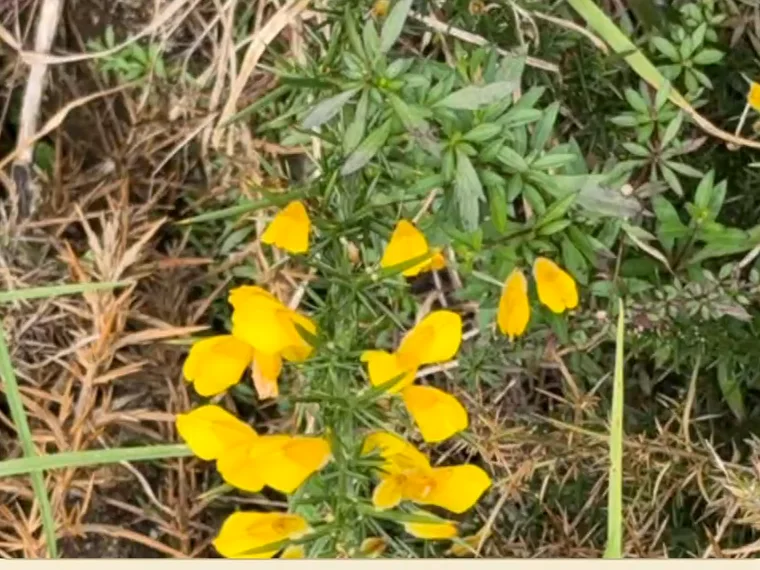
Common gorse near Kodaikanal, one of Tamil Nadu's 23 priority invasive plants.
Alien, naturalised, invasive: three different words
People often call any non-native plant "invasive". Tamil Nadu's policy on invasive plants, TN PIPER, is stricter, and its definitions are the ones I've used:
- Alien (also introduced or exotic): present in the state because of people, brought in deliberately or by accident.
- Naturalised: an alien plant that has kept reproducing in the wild on its own for at least ten years, usually close to the parent plants, without spreading into natural habitats.
- Invasive: produces offspring in very large numbers, often far from the parent plants, and can spread over large areas and into natural ecosystems.
The policy's Appendix 1 lists 196 invasive alien plant species in the state, and it names 23 of them as priorities for removal. Separate appendices list species that are only naturalised or casual. For every plant below, I've used the policy's lists for its status, not my judgement.
What I found
| Plant | Native to | Status in Tamil Nadu | SASYA's match |
|---|---|---|---|
| Common gorse | Western Europe | Invasive, a state priority | 97% |
| Crofton weed | Mexico | Invasive | 97% |
| Bugweed | South America | Invasive | 90% |
| Dawn flower | Tropical America | Invasive | 95% |
| Bigleaf periwinkle | Mediterranean | Naturalised | 95% |
| Jelecote pine | Mexico | Planted; not on the invasive list | 91% |
| Banana passion flower | The Andes | Not listed | 81% |
| Hardy fuchsia | Chile and Argentina | Not listed | 61% |
| Dandelion | Europe and Asia | Not listed | 99% |
| Nilgiri rhododendron | Native, Western Ghats endemic | Native; Endangered | 87% |
Common gorse (Ulex europaeus)
Spiny, yellow-flowered, and one of the state's 23 priority invasives. Gorse comes from Western Europe. In the Nilgiris, ecologists note that it has "invaded the grasslands extensively in recent years", alongside other woody shrubs such as Scotch broom (Das, Ratnam & Jathanna 2023). Around the world its main harm is crowding out native plants and animals, and it also impoverishes soil and is a fire hazard (review of gorse impacts).
Crofton weed (Ageratina adenophora)
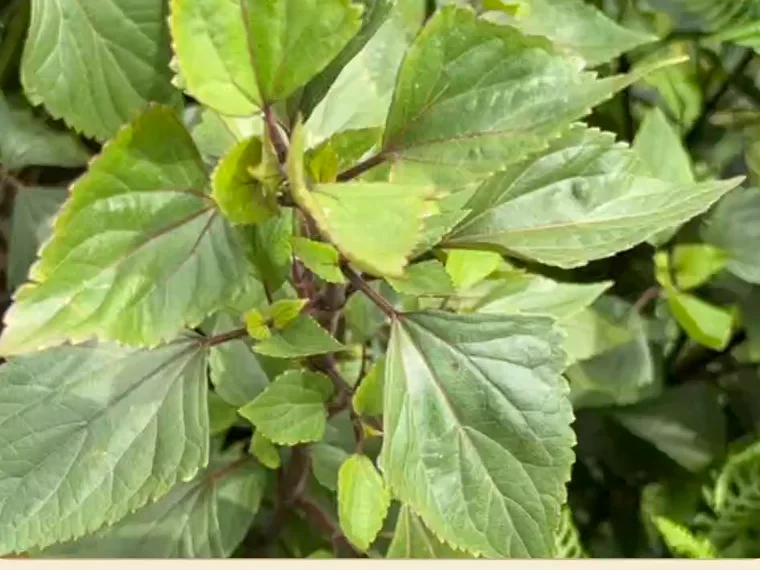
A soft herb with toothed, diamond-shaped leaves on purplish stems, from Mexico and on the state's invasive list. It produces huge numbers of light seeds and its seedlings grow fast, which researchers studying it in Bhutan found are the main drivers of its spread (study of Crofton weed in Bhutan). More on its species page.
Bugweed (Solanum mauritianum)
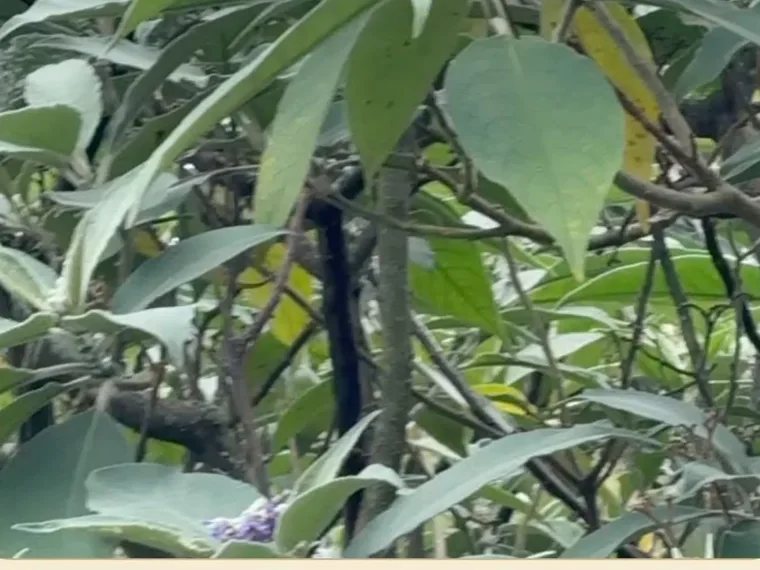
A shrub or small tree with large, soft, grey-green leaves, also called wild tobacco. The state list gives its origin as Argentina, Brazil and Uruguay, and lists it as invasive. Species page.
Dawn flower (Ipomoea indica)
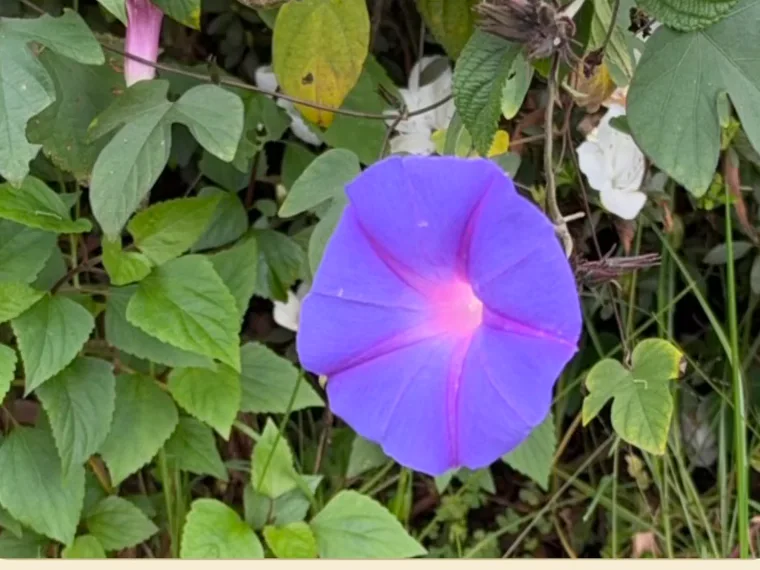
The big blue morning glory climbing over hedges and fences. It's grown in gardens for its flowers, comes from tropical America, and is on Tamil Nadu's invasive list. Species page.
Bigleaf periwinkle (Vinca major)
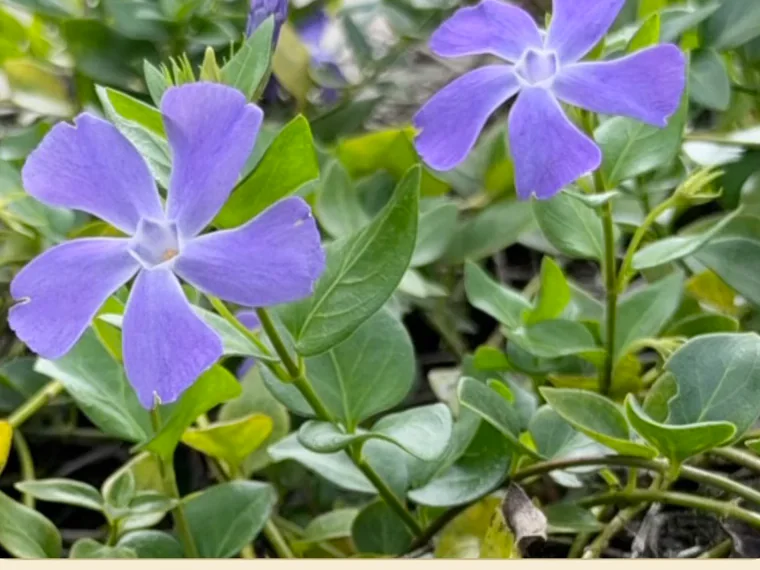
A Mediterranean ground cover with violet flowers. The state lists it as naturalised: it grows wild, but it isn't on the invasive list. Not every escaped garden plant is a problem, which is exactly why the categories exist.
Jelecote pine (Pinus patula)
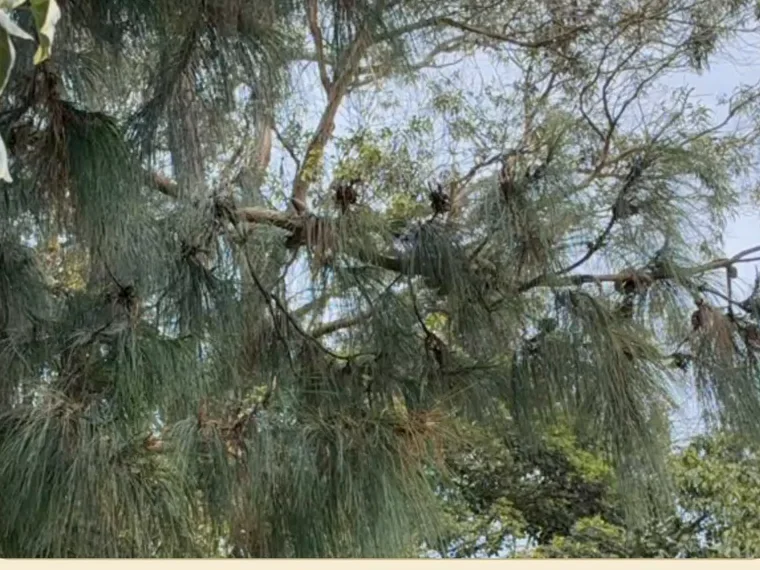
Kodaikanal's pine forests are among the town's best-known sights, and they are plantations. The pine I scanned, Jelecote pine, comes from Mexico, and it has been planted on a plantation scale in the Kodaikanal hills since 1968 (Indian Forester, on tropical pines in Tamil Nadu). Pine isn't on the state's invasive list, but it is part of a bigger story. A study of the Palani Hills found that over four decades they lost about 66% of their native montane grasslands and 31% of their native forests, mostly to timber plantations and partly to farming (Arasumani et al. 2018). The study names the introduced timber trees as wattle (Acacia mearnsii), eucalyptus and pines, and notes that some plantation species, most notably wattle, are recognised invaders. The study's title makes the point well: "Not seeing the grass for the trees". Grassland is easy to mistake for empty land waiting to be planted, but the open grassland between the shola forests is a habitat in its own right.
Banana passion flower (Passiflora tarminiana)
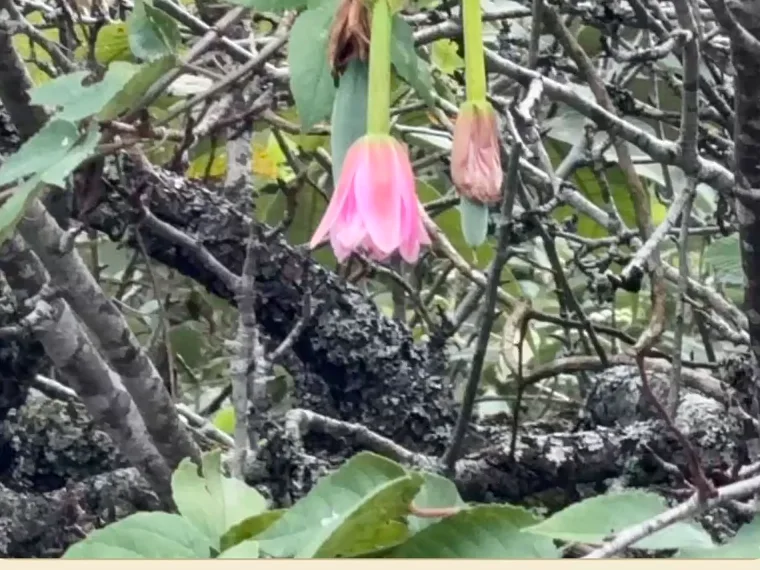
A vine with pink, hanging, tubular flowers, native to the uplands of tropical South America. It isn't on Tamil Nadu's invasive list. It is a well-known invader in Hawaii and New Zealand (overview), so it's one to watch. Species page.
Hardy fuchsia (Fuchsia magellanica)
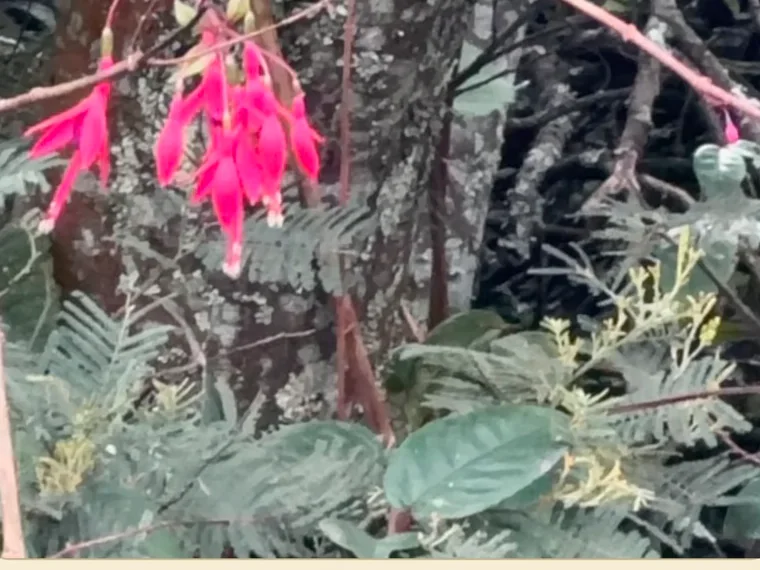
A garden plant from southern Chile and Argentina, growing wild along the trail. It isn't on the state list. SASYA was less sure about this one (61%, "possible match"), but the hanging red-and-purple flowers are distinctive. The feathery leaves behind it look like wattle, which is a state priority, but I didn't scan it, so I can't be sure. Species page.
Dandelion (Taraxacum officinale)
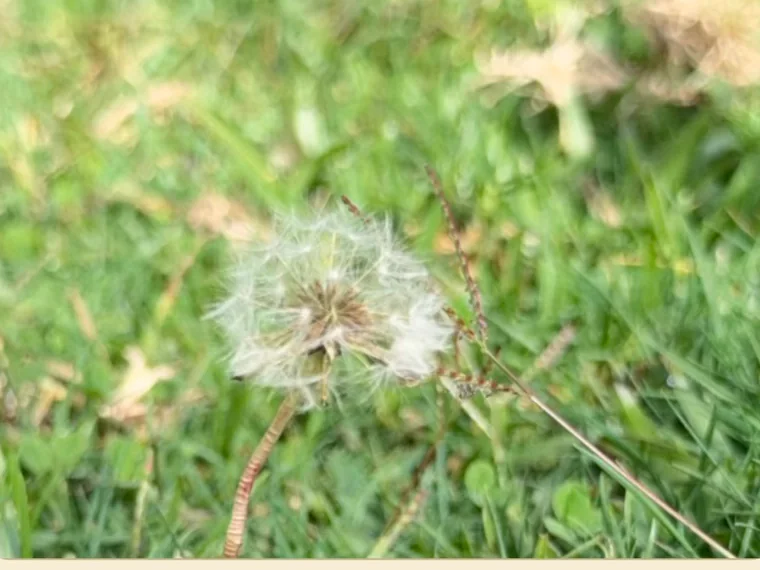
From Europe and Asia, and common in the town's lawns. Not on the state list. Species page.
The rare one
I had spent the holiday looking for something rare. Reading up afterwards, I realised I had found one.
Nilgiri rhododendron (Rhododendron arboreum subsp. nilagiricum)
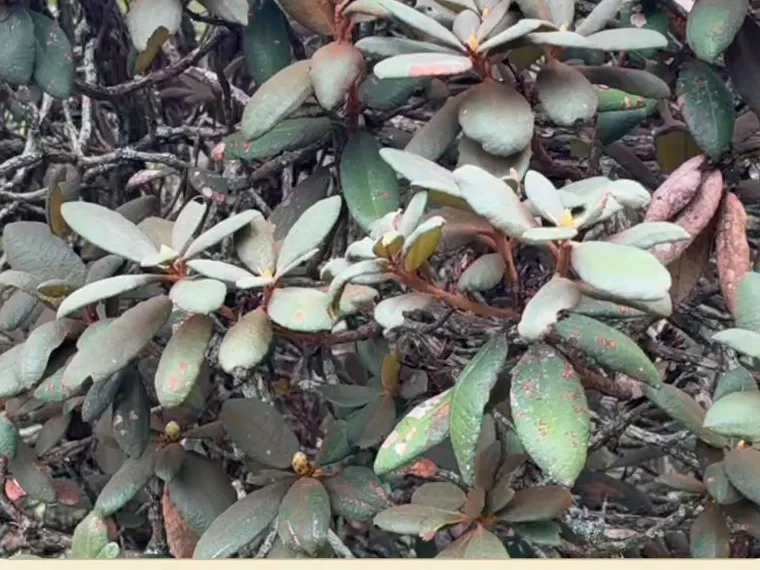
A small tree of the shola forests, up to about 10 metres tall, endemic to the Western Ghats. It is common in the Nilgiri, Anamalai and Palani hills and rare in the Varushanad Hills (Flowers of India; eFlora of India). Of the ten plants in this post, it is the only one that belongs here, and it is in trouble. The 2011 Red List of Rhododendrons lists it as Endangered. The threats it names are logging, forest fires, drought from reduced rainfall, and acacia and eucalyptus plantations replacing the native vegetation of the Western Ghats (Red List of Rhododendrons, 2011). That is the same plantation story as the grasslands above. Species page.
How to recognise it, even out of flower:
- Leaves bunched at the twig tips, spiralling around the stem rather than spaced along it.
- Thick, leathery leaves, smooth on top with sunken veins, and dry and scurfy underneath, with the edges rolled slightly under. In my photo you can see the paler undersides.
- Crimson, bell-shaped flowers in tight clusters at the ends of the branches.
- Woody, oblong seed capsules about 2 cm long, which split open to release many tiny winged seeds.
- Brownish, fissured bark that shows pink when cut.
The bigger picture
The plants I happened to scan aren't even the biggest problems. By the Forest Department's estimates in TN PIPER, lantana alone covers around 1.66 to 1.85 lakh hectares of the state's forest divisions, black wattle 16,000 to 22,400 hectares, and the major invasive species together roughly 2.7 to 3.2 lakh hectares (TN PIPER). The two estimates differ quite a bit, and the policy itself says to treat them as broad approximations.
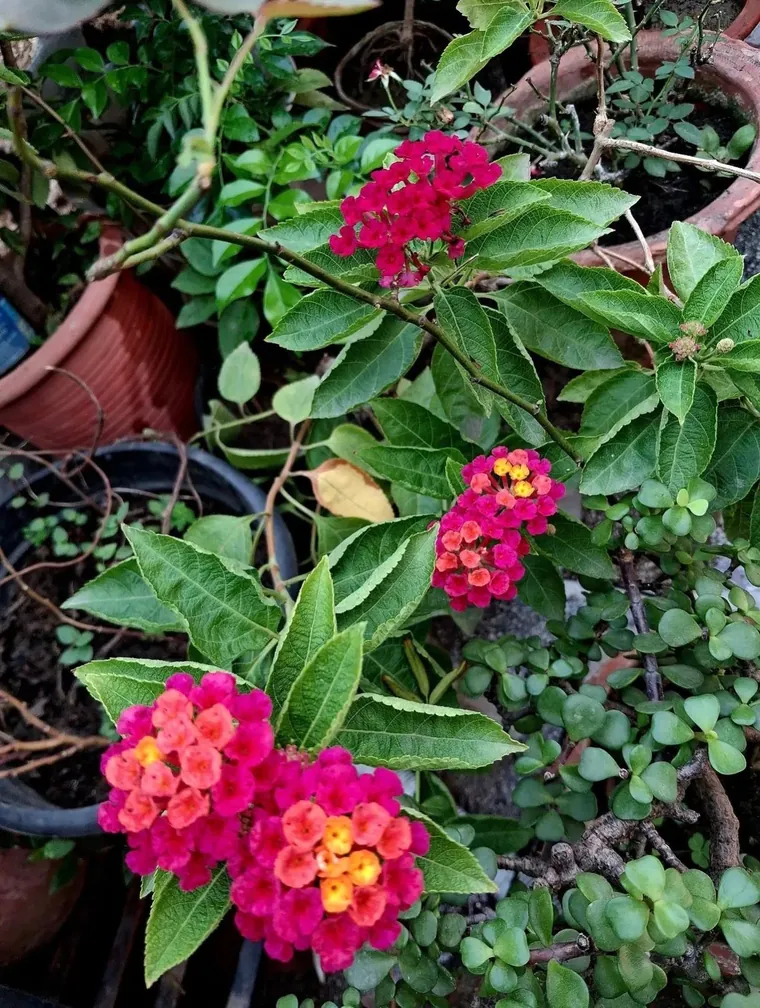
Lantana in pots in Kodaikanal. It is the most widespread invasive plant in Tamil Nadu's forests, and it is still grown as a garden plant.
The Madras High Court has also pushed hard on this. An expert committee it constituted gathered many of these estimates, and it has repeatedly told the state to remove invasive plants from forests (LiveLaw). In the Nilgiris, a 2019 interim report by that committee warned that wattle is replacing grasslands and shola forests, and that plantations of eucalyptus, pines and cypress have "virtually wiped out" grasslands and sholas (Down To Earth).
Restoration is happening too. TN PIPER credits the shola-grassland restoration work of the Vattakanal Conservation Trust in Kodaikanal with helping to identify priority areas for restoring montane grassland.
What you can do
- Plant natives. Many invasives arrived on purpose: lantana was spread for hedges and gardens, dawn flower is grown for its flowers, and wattle was planted for timber. Before buying a plant at a nursery, check that it isn't on the state's invasive list.
- Don't carry seeds. After a hill walk, brush off your shoes and clothes. Crofton weed and gorse spread by seed.
- Record what you see. TN PIPER names citizen-science portals like iNaturalist and the India Biodiversity Portal as useful ways to monitor invasive plants. A photo with a location is a data point.
- Learn to recognise them. SASYA works offline, which helps on hill roads with no signal. Treat a scan as a starting point: check with a field guide or a local expert before you pull anything out, because native look-alikes exist.
What I'm taking home
The hills were still beautiful. I just see them differently now. Most of the colour that caught my eye came from somewhere else, and the plant that truly belonged was the quiet one with leathery leaves, easy to walk past. If you visit, look past the flowers by the road. The grasslands and the shola edges are where the hills' own plants are holding on.
How these photos were taken
Every photo here is mine, captured by SASYA during a scan, on roadsides and trails around Kodaikanal during our holiday in October 2026. The percentage in the table is the app's confidence for that one scan, not a measure of how common the plant is. I only kept scans where the photo clearly matched the name. The lantana photo is the exception: I took it with the phone camera in Kodaikanal, not during a scan.
Sources
- Tamilnadu Policy on Invasive Alien Plant Species and Ecological Restoration of Habitats (TN PIPER): species lists (Appendices 1 to 4), 23 priority species, area estimates.
- Performance of Tropical Pines and their Provenances in Tamil Nadu, Indian Forester: plantation-scale planting of Pinus patula in the Kodaikanal hills from 1968.
- Arasumani et al. 2018, PLoS ONE: Not seeing the grass for the trees: grassland and forest loss in the Palani Hills.
- Das, Ratnam & Jathanna 2023, Frontiers in Ecology and Evolution: woody invaders, including gorse and wattle, in Nilgiri grasslands and sholas.
- A mini-review on the impact of common gorse in its introduced ranges.
- Farmer perspectives on invasive Ageratina adenophora in Bhutan.
- eFlora of India: Rhododendron arboreum ssp. nilagiricum.
- Flowers of India: Nilgiri Rhododendron.
- Gibbs, Chamberlain & Argent 2011, The Red List of Rhododendrons (Botanic Gardens Conservation International): lists the Nilgiri rhododendron as Endangered.
- Down To Earth: Invasive species may soon wipe out Shola vegetation from Nilgiris.